Which FR4 Fiber Glass Laminate Sheet Features Matter for Aerospace and Industrial Electronics?
When engineering teams ask which FR4 fiber glass laminate sheet features matter most for aerospace and industrial electronics, the short answer covers five areas: UL 94 V-0 flame retardancy, high dielectric breakdown voltage, bending strength above 500 MPa, low moisture absorption, and tight dimensional tolerances. Hongda's Flame Resistance FR4 Fiber Glass Laminate Sheet — built on an epoxy resin and woven fiberglass cloth system — meets all five benchmarks, as confirmed by GB/T 1303.4-2009 test data. These properties collectively protect circuits operating under thermal stress, vibration, and chemical exposure in the most demanding operating conditions.
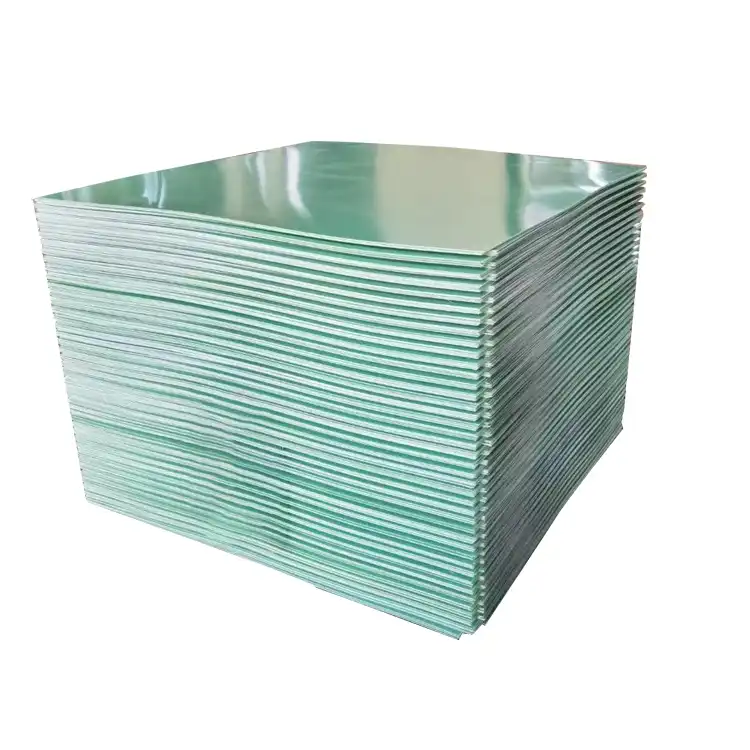
Understanding Flame Resistant FR4 Fiber Glass Laminates
The fire-resistant label on FR4 laminates comes from the way the materials are built. Brominated or phosphorus-based epoxy glue is mixed with woven fiberglass cloth. This stops the burning cycle at the molecular level. The National Electrical Manufacturers Association (NEMA) sets the FR-4 grade standard, and all sheets that meet it must get UL 94 V-0, which means that test specimens put out themselves within ten seconds of the flame being turned off.
What Makes the Epoxy Matrix So Effective
When the epoxy glue hardens, it forms a three-dimensional network of cross-links that stops heat and air from getting through. The resin stays strong when it comes to bonding with the glass fiber weave, even at high temperatures. This stops delamination, which is one of the most common ways that aerospace PCB assemblies fail.
How the Glass Fiber Weave Adds Mechanical Stability
The mechanical loads are spread out along both axes of the sheet of continuous filament glass cloth. This structure gives FR4 its well-known dimensional stability, which is very important when circuit boards have to deal with temperature changes between very cold temperatures at high altitude and heat from electronics on board.
Why FR4 Replaced G-10 in Aerospace Contexts
G-10 has a similar glass-epoxy composition, but unlike the Flame Resistance FR4 Fiber Glass Laminate Sheet, it is not formulated with the same flame-retardant characteristics. As aerospace and other demanding industries placed greater emphasis on fire resistance, conventional G-10 could not satisfy certain application requirements where flame performance was essential. The development of the Flame Resistance FR4 Fiber Glass Laminate Sheet addressed this requirement while retaining the strong mechanical and electrical properties associated with glass-epoxy laminate materials. Because the Flame Resistance FR4 Fiber Glass Laminate Sheet combines electrical insulation, mechanical strength, and flame-retardant performance, it became widely adopted as a foundational material for rigid PCB applications. Today, the Flame Resistance FR4 Fiber Glass Laminate Sheet remains an important choice for engineers who need a balance of dielectric performance, structural stability, and flame resistance. For applications requiring these combined properties, the Flame Resistance FR4 Fiber Glass Laminate Sheet provides a practical alternative to non-flame-retardant glass-epoxy materials such as conventional G-10.
Key Performance Features for Aerospace and Industrial Electronics
There is more to picking the right epoxy fiberglass laminate for tough jobs than just looking at its flame rating. There are four performance factors that show how long a material will last in use.
In terms of technology, these are the most important ones:
- Thermal resistance: Hongda FR4 sheets maintain structural integrity up to the glass transition temperature range while dielectric properties remain stable. The vertical layer breakdown voltage tested at 90 °C measures 16.7 kV/mm, confirming that insulation does not degrade under operating heat.
- Mechanical strength: Bending strength perpendicular to laminations reaches 571 MPa, and compressive strength reaches 548 MPa per GB/T 1303.4-2009. These figures support use as structural spacers, mounting panels, and busbar supports in machinery and switchgear.
- Dielectric performance: Parallel layer breakdown voltage exceeds 100 kV, and insulation resistance after soaking measures 2.2×10¹³ Ω. Both figures confirm that the sheet maintains signal integrity and prevents leakage currents even after humidity exposure.
- Chemical resistance: The cured epoxy system resists most industrial solvents, hydraulic fluids, and cleaning agents. This is particularly important in automotive battery pack barriers and aerospace structural components that may contact fluid contaminants.
All four of these things work together. A laminate that is strong mechanically but not very good at conducting electricity poses a safety risk, and one that is good at flame resistance but has unstable dimensions leads to problems with assembly. Before approving a specification, procurement teams should ask for full technical datasheets and compare the results with their own application environment.
Comparing Flame Resistant FR4 Laminates with Alternatives for Electronics Manufacturing
FR4 is not the only insulation material on the market, and engineering managers can make more informed purchasing decisions by understanding the advantages and limitations of each option. The Flame Resistance FR4 Fiber Glass Laminate Sheet offers a useful combination of flame resistance, electrical insulation, mechanical strength, and dimensional stability for many industrial applications. However, the Flame Resistance FR4 Fiber Glass Laminate Sheet may not be the most suitable choice for every operating environment, particularly when an application requires properties beyond its specified temperature, chemical, mechanical, or dielectric range. When comparing materials, engineers should evaluate the Flame Resistance FR4 Fiber Glass Laminate Sheet against alternatives according to actual load conditions, temperature exposure, moisture, electrical requirements, and applicable safety standards. Procurement teams should also consider supplier quality control, certification documentation, machining requirements, and long-term availability when sourcing a Flame Resistance FR4 Fiber Glass Laminate Sheet. By reviewing these factors systematically, buyers can determine whether the Flame Resistance FR4 Fiber Glass Laminate Sheet matches the technical and commercial requirements of their specific application.
FR1 and FR2 Paper-Based Laminates
These two types of reinforcements don't use glass fiber; instead, they use paper. Some materials are cheaper and easier to work with, but they absorb water much more quickly, aren't as strong, and can't be used for the through-hole plating methods that aircraft PCBs need.
CEM3 Composite Epoxy Material
CEM3 has a glass fabric top and a glass mat bottom. In terms of bending strength and dielectric breakdown voltage, it's not as good as woven glass FR4, but it's better than paper-based grades. CEM3 is good for lower-frequency consumer electronics, but it isn't often used for structural insulation in aerospace.
High-Tg FR4 Variants
Some types of FR4 have a glass transition temperature (Tg) above 170 °C, which means they can be used for high-power tasks and lead-free soldering. Standard FR4 is good for most industrial electronics needs, and High-Tg versions are better for the hottest and coldest situations. Both are made of epoxy fiberglass and have the same UL 94 V-0 rating.
Procurement Insights: Sourcing FR4 Laminate Sheets
There's more to finding a good FR4 laminate provider than just checking prices. Before making an order, procurement teams in the aerospace and power industries always look at a number of factors related to the provider.
The most important thing is uniformity from batch to batch. Differences in size between production runs make it hard for precision assemblies to fit together. Hongda's FR4 sheets come in thicknesses ranging from 0.3 mm to 100 mm, and their standard size is 1030 mm × 1230 mm. They also offer custom sizes, such as 1220 mm × 2440 mm, to cut down on waste in large-format cutting operations. The light green color (natural epoxy glue) makes it easier to see during quality control of new goods.
The second factor is manufacturing capacity. J&Q's manufacturing partner produces approximately 13,000 tons of FR4 material each year, while the combined output of both factories reaches about 43,000 tons annually. This production scale supports larger orders of Flame Resistance FR4 Fiber Glass Laminate Sheet while helping maintain stable supply and avoid unnecessary increases in lead times. For procurement teams, sufficient manufacturing capacity is particularly important when sourcing Flame Resistance FR4 Fiber Glass Laminate Sheet for large-scale electrical insulation or industrial projects. The minimum order quantity is 500 kg, giving buyers a defined starting volume for purchasing Flame Resistance FR4 Fiber Glass Laminate Sheet according to project requirements. For international customers, Flame Resistance FR4 Fiber Glass Laminate Sheet can be arranged for sea, land, or air freight depending on shipment volume and delivery requirements. T/T is the stated payment method, providing a straightforward B2B purchasing arrangement for customers ordering Flame Resistance FR4 Fiber Glass Laminate Sheet. With substantial production capacity, flexible transportation options, and defined order terms, J&Q can support procurement teams seeking a stable supply of Flame Resistance FR4 Fiber Glass Laminate Sheet.
The third requirement is proof of certification. Before agreeing to large orders, buyers should ask for flame retardancy test certificates, dielectric strength reports, and records of third-party inspections. J&Q gives procurement teams the technical datasheets and test data that are in line with GB/T standards. This gives them the paper trail they need for aircraft qualification processes.
Ensuring Quality and Compliance: Testing and Verification
Quality control for epoxy fiberglass laminate is not just one test; it is a series of checks that look at how it reacts to fire, how well it works mechanically, and how well it works electrically.
UL 94 V-0 Flame Testing
For a flammability grade V-0 test, the specimens must be able to put out their own fire within ten seconds, and there can't be any flaming drips that light cotton below the sample on fire. This is the rating that Hongda FR4 gets according to GB/T 2408-2008. It is the same as the UL 94 V-0 rating that is accepted by foreign certification groups.
Mechanical Verification Under Load
Barcol hardness testing (result: 76 per GB/T 3854-2005) and impact strength measurement (57.3 KJ/m²) show that sheets won't chip or crack during CNC machining, which is a common way to make test fixtures, insulation plates, and structural parts.
Moisture and Chemical Resistance Testing
Testing for water absorption on standard sample amounts confirms a value of 5.3 mg, which keeps the dielectric properties stable in humid work settings. The next step is to test the chemical protection by modeling contact with the solvents and process fluids that are common in factories that make motors and batteries.
Conclusion
The Flame Resistance FR4 Fiber Glass Laminate Sheet is widely used in aerospace and industrial electronics because it combines flame resistance, mechanical strength, and stable dielectric performance in one insulation material. Hongda's FR4 sheet is produced to meet applicable GB/T requirements and UL 94 V-0 flame-retardant performance, providing a documented basis for applications where electrical insulation and fire resistance are important. The Flame Resistance FR4 Fiber Glass Laminate Sheet is available in thicknesses ranging from 0.3 mm to 100 mm, with customized forms available for different engineering requirements. For technical procurement teams, the Flame Resistance FR4 Fiber Glass Laminate Sheet can be specified according to the required thickness, dimensions, electrical properties, and application conditions. J&Q has more than 20 years of manufacturing experience and provides integrated logistics support, helping customers coordinate production and transportation when sourcing Flame Resistance FR4 Fiber Glass Laminate Sheet for long-term projects. With documented material requirements, flexible specifications, and established supply capabilities, the Flame Resistance FR4 Fiber Glass Laminate Sheet can support engineers and procurement managers who require consistent insulation materials for demanding aerospace and industrial electronics applications.
FAQ
What distinguishes flame-resistant FR4 from standard G-10 sheets?
Flame-resistant FR4 incorporates bromine- or phosphorus-based additives in its epoxy resin matrix, enabling it to pass UL 94 V-0 testing. G-10 shares the same glass fiber structure but lacks those retardant additives, which makes it unsuitable for aerospace and industrial applications that require documented fire safety compliance.
Can FR4 laminate be cut to non-standard dimensions?
Yes. Hongda FR4 sheets ship in standard 1030 mm × 1230 mm panels but are also available in custom sizes such as 1220 mm × 2440 mm and 1030 mm × 2030 mm. CNC routing and waterjet cutting both work well on this material, and tight thickness tolerances across the full 0.3 mm to 100 mm range support precision machining.
How should procurement teams verify a supplier's compliance claims?
Request the full technical datasheet, independent flame retardancy test certificates, and dielectric strength test reports. Cross-check test methods against recognized standards such as GB/T 2408-2008 for flammability and GB/T 1303.4-2009 for mechanical properties. For aerospace programs, also ask whether the supplier maintains a documented quality management system with traceable batch records.
Source Your FR4 Laminate Through J&Q — Get a Quote Today
J&Q has been making shielding materials for over 20 years and dealing internationally for over 10 years. They sell Flame Resistance FR4 Fiber Glass Laminate Sheet to engineering teams all over the United States. As a reliable FR4 laminate manufacturer, we offer tested UL 94 V-0 performance, custom sizing, stable batch quality, and end-to-end logistics managed by our own freight operation. This means that your order gets from the production floor to your facility as quickly as possible. To get a brochure and quote, email info@jhd-material.com with your requirements and the amount you want to buy, or go to blog.jhd-material.com.
References
1. National Electrical Manufacturers Association (NEMA). NEMA LI 1: Industrial Laminating Thermosetting Products. NEMA, 2020.
2. Underwriters Laboratories. UL 94: Standard for Tests for Flammability of Plastic Materials for Parts in Devices and Appliances. UL, 2018.
3. Coombs, C. F., & Holden, H. T. Printed Circuits Handbook, 7th ed. McGraw-Hill Education, 2016.
4. Harper, C. A. Electronic Materials and Processes Handbook, 3rd ed. McGraw-Hill, 2004.
5. Goodman, S. H. (Ed.). Handbook of Thermoset Plastics, 2nd ed. Noyes Publications, 1998.
6. IPC Association Connecting Electronics Industries. IPC-4101: Specification for Base Materials for Rigid and Multilayer Printed Boards. IPC, 2017.

Get a complete product list and quotation

J&Q New Composite Materials Company



