Where Is Phenolic Paper Sheet Used in Electrical Manufacturing?
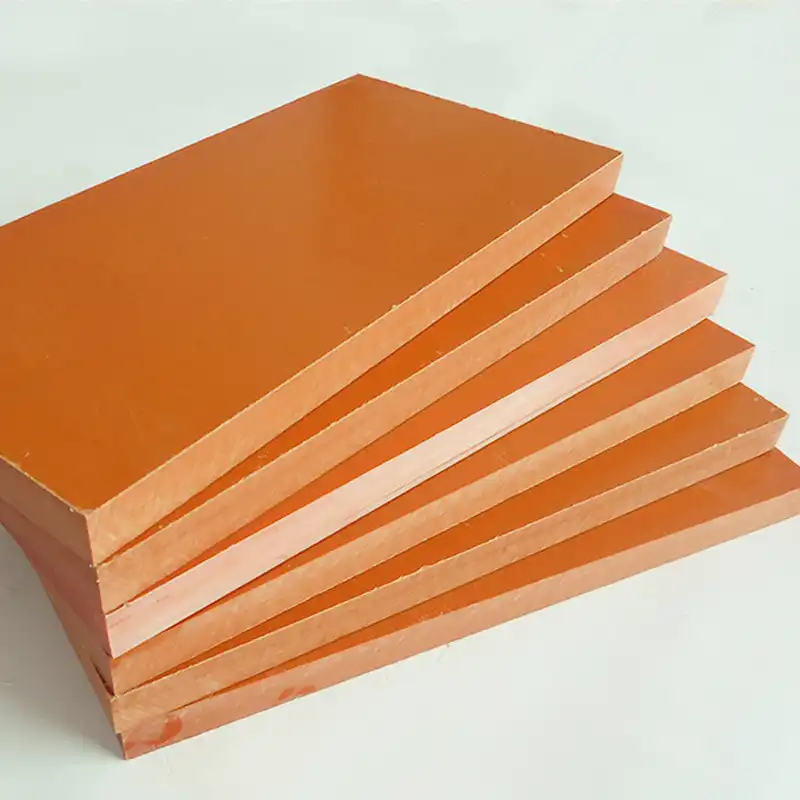
Phenolic paper sheet plays a foundational role in electrical manufacturing across the United States. This rigid laminated composite — made from kraft paper impregnated with phenolic resin and cured under heat and pressure — appears in a wide range of applications. Engineers rely on it for insulating washers, transformer supports, switchgear components, terminal blocks, and PCB drilling backup boards. Its dielectric strength, cold-punching capability, and cost-efficiency make it a practical solution wherever reliable electrical isolation is needed without the premium cost of glass-fiber-based alternatives.
What Is Phenolic Paper Sheet and Why Does It Matter?
The Material Behind the Name
Phenolic Paper Sheet is a thermosetting composite at its core. The phenolic resin is slowly soaked into sheets of cellulose kraft paper. The sheets are then cooked and hot-pressed into a thick, hard panel. The end result is a Class E insulating material that can work continuously up to 120°C and has a dielectric strength that is usually higher than 10 kV/mm when tested in oil.
The density is usually between 1.30 and 1.45 g/cm³, and the flexural strength is at least 120 MPa when viewed opposite to the lamination line. These numbers are important for tech managers who need to know how well each batch of products will work.
Grades and What They Signal
The NEMA numbers X, XX, and XXX show how much plastic is in the product and how well it resists water. The X grade is meant for use in mechanical settings. It adds some power efficiency, but not much. XXX has the most resin saturation and the best resistance to humidity and dielectric stability. It is possible to cold punch grades with a "P" ending, like XP or XXXP, without the edges cracking. This feature greatly cuts down on tooling time in high-volume pressing processes.
It's not a small matter to understand grade differences. If you specify the wrong grade, the insulation could fail early, production could be stopped, or safety issues could happen, none of which the buying team wants to explain.
Where Phenolic Paper Sheet Is Actually Used in Electrical Manufacturing?
People who buy this stuff find it in more places than they think at first. The versatility of Phenolic Paper Sheet comes from the fact that it is electrically insulating, easy to work with, resistant to chemicals, and reasonably priced.
Here are the main places where phenolic paper laminate has been shown to be useful:
- PCB Drilling Backup Boards: Phenolic Paper Sheet is the standard for drill entry and backup boards in large-scale printed circuit board production. Its hardness is just right to keep micro-drill bits safe and copper-clad laminates from getting burrs. When this job is done, switching to harder fiberglass materials speeds up drill wear and makes the cost of making each unit much higher.
- Transformer and Switchgear Insulation: Phenolic laminate is used in power distribution equipment for busbar supports, coil spacers, and arc barriers. When submerged in transformer oil, the material keeps its shape, showing long-term chemical resistance that mineral-based alternatives can't consistently match.
- Punched Washers, Gaskets, and Terminal Strips: Automobile starting motors, home appliances, and motor systems use stamped phenolic parts to keep metal parts electrically separate in small, moving spaces. Cold-punchable grades make it cheap to make a lot of these parts without lowering the quality of the measurements.
In all of these uses, one thing is common: they need a material that reliably insulates, cuts cleanly, and holds up under moderate thermal and mechanical stress, but doesn't cost as much as epoxy glass composites.
Beyond these core uses, Phenolic Paper Sheet is also used as fixture boards in CNC machining settings. Because it isn't rough, it makes carbide tools last longer than with glass-fiber laminates, so precision fabrication shops like to use it as a sacrificial material.
Phenolic Paper Sheet vs. Alternative Insulating Materials
In electrical uses, people who work in procurement often want to know how Phenolic Paper Sheet stacks up against FR4, epoxy glass, or plain plywood. What you are aiming for will tell you the truth.
FR4 is made of woven glass fiber and epoxy resin, which makes it more resistant to water and stronger. It works well in tough conditions, but tools wear out much faster, and the cost of materials goes up. In situations where Class E temperature ratings and dry or oily service conditions are okay, Phenolic Paper Sheet provides the same level of electrical protection for a lot less money.
Epoxy glass laminates raise the temperature ceiling above 130°C and make it harder for moisture to get in. It makes sense to use them in space or outside. That extra cost rarely leads to better results inside switchgear panels or transformer units that work in controlled settings.
For real electrical insulation, plywood doesn't do anything. It takes in water, its dielectric qualities aren't uniform, and it's not fireproof. Phenolic Paper Sheet does better in every way that matters for making electronics.
For buying teams, this is a simple lesson: Phenolic Paper Sheet is usually the most cost-effective standard when the application works inside or in oily conditions at temperatures below 120°C.
Procurement Considerations for B2B Buyers
What to Confirm Before Placing an Order?
To get Phenolic Paper Sheet on a large scale for production, you need to pay attention to a number of factors. For automated production lines, consistency in thickness tolerance across runs is very important. Custom sizes cut down on waste from cutting later on. Buyers in regulated markets are protected by compliance documents, such as RoHS conformity and appropriate UL or IEC certifications.
Total landed cost is affected by minimum order quantities, lead times, and packaging standards. When buyers work with a manufacturer that also takes care of its own logistics, they have more control over delivery times and don't have to keep as much extra inventory on hand.
Quality Signals That Matter
Trustworthy sellers give out more than just product datasheets; they also give out traceable material certificates. In professional B2B procurement, you should get a sample before you commit to buying a lot of something. After-sales technical support, especially help with choosing the right grade, is what sets makers with real application knowledge apart from generic middlemen.
OEM customers who use automated punching or CNC operations must have consistent batch quality. One batch that doesn't meet standards can stop the whole production line and require expensive rework.
Conclusion
Phenolic Paper Sheet has been used in the electrical industry for decades because it works well. It reliably insulates, machines cleanly, punches well, and doesn't react with oils and solvents that are common in industrial settings. It can be used in many fields, from power transfer to consumer electronics, for things like transformer parts and PCB production tools. When procurement professionals look at insulating materials, the question they really want to know is not whether the material works, but whether they can get it from a source whose quality systems, certifications, and procedures meet their production needs.
FAQ
What is the continuous operating temperature of phenolic paper laminate?
Phenolic Paper Sheet is rated Class E, which means it can work continuously at 120°C. Long-term exposure above this level turns the paper substrate into carbon, which changes it from an insulator to a conductor. This is a very important way for electrical assemblies to fail.
Can this material be used in outdoor applications?
No, UV light breaks down the phenolic resin over time, and changes in humidity can cause it to separate. This material is designed to be used indoors or in places where oil is present. For outdoor electrical uses, UV-stabilized plastics with sealed edge treatments are needed.
What does the "P" suffix mean in NEMA grades?
The letter "P" means that the grade can be punched. Plasticizers are added to the resin system so that the edges don't crack when it's cold stamped. For non-P grades, hot tools may be needed to keep them from breaking when they are punched.
How does it compare to FR4 for PCB support applications?
FR4 is more resistant to water and has a higher mechanical strength. Phenolic Paper Sheet is a cheaper option for insulation needs and is easier to work with when cutting, which is important for drilling backup boards where reducing tool wear is important.
Is phenolic paper laminate RoHS compliant?
Grades that are compliant are easy to find and can be proven. RoHS status must be checked at the material batch level, not just based on the product category, so buyers should ask suppliers for written certification.
Source Phenolic Paper Sheet from J&Q — Request a Quote Today
J&Q has been making insulating sheets for more than 20 years and has been trading with other countries for more than 10 years. We are a reliable provider of Phenolic Paper Sheet, and we offer certified grades, stable batch quality, custom sizes, and full services through our own freight infrastructure. If you email your requirements to info@jhd-material.com, our technical team will get back to you within one business day with grade suggestions and a fair price.
References
1. NEMA Standards Publication LI 1 — Industrial Laminated Thermosetting Products, National Electrical Manufacturers Association, 2020.
2. IEC 60893-3-4 — Industrial Rigid Laminated Sheets Based on Thermosetting Resins for Electrical Purposes, International Electrotechnical Commission, 2003.
3. Harper, C.A. — Handbook of Plastics Technologies, McGraw-Hill, 2006.
4. Brydson, J.A. — Plastics Materials, 7th Edition, Butterworth-Heinemann, 1999.
5. UL 746B — Polymeric Materials — Long Term Property Evaluations, Underwriters Laboratories, 2013.
6. Seanor, D.A. — Electrical Properties of Polymers, Academic Press, 1982.

Get a complete product list and quotation

J&Q New Composite Materials Company



