EPGC308 Epoxy Sheet for High Temperature Motor Insulation Applications
When motor insulation fails under thermal stress, the consequences ripple across entire production lines. The EPGC308 epoxy sheet is a Class H-rated industrial laminate built specifically to prevent that failure. Engineered under IEC 60893-3-2 with woven glass fiber reinforcement and a high-temperature epoxy resin system, this material sustains continuous operation at 180°C while retaining structural integrity that standard FR4 or G10 simply cannot match. For engineering managers and procurement teams sourcing insulation for motors, switchgear, or transformer components, this guide delivers the technical and sourcing clarity you need.
Understanding EPGC308 Epoxy Sheet: Properties and Specifications
Thermal and Electrical Performance
This laminate's glass transition temperature (Tg) is higher than 170°C, which puts it in the IEC Class H thermal endurance category. When tested in oil, the dielectric strength is at least 10 kV/mm perpendicular to the laminate, and the Comparative Tracking Index (CTI) can go up to 600V, but this depends on the resin formulation. In high-voltage motor settings, where shielding breaks down over time in hot conditions, leading to arc problems and winding failures, these values are very important.
Mechanical Strength at Elevated Temperatures
Flexural strength at room temperature is at or above 340 MPa, but hot strength preservation is the more important number. IEC 60893-3-2 says that an EPGC308 sheet that meets the requirements must keep at least half of its bending strength when tested at 150°C after being heated for an hour. This makes sure that the motor's slot wedges, packing blocks, and structural spacers stay the same size even when they are under mechanical and thermal loads.
Product Specifications from J&Q (JingHong Brand)
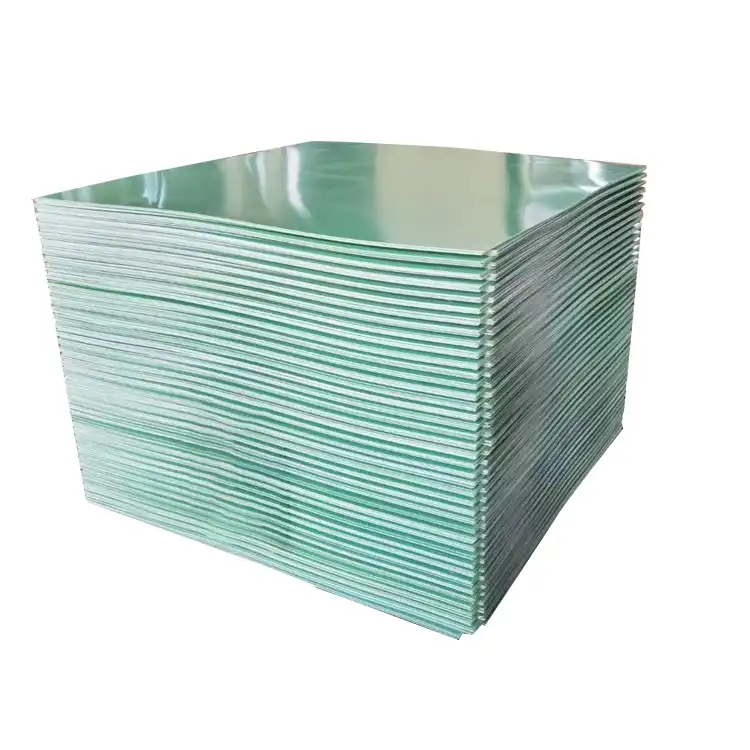
J&Q makes Epgc308 Epoxy Sheet under the JingHong brand and can make 43,000 tons of it every year. Thicknesses range from 0.3mm to 100mm. The standard sheet size is 1030mm × 1230mm, but special sizes are also available, such as 1030mm × 2030mm, 1220mm × 2440mm, and 1030mm × 2070mm, for cutting in big areas. The stuff is shipped flat in boxes and is its usual light green color. The smallest amount you can order is 500 kg, and you can pay with T/T. Shipping can happen by sea, land, or air freight.
Comparative Analysis: EPGC308 vs Other Epoxy Sheets and Insulating Materials
To pick the correct insulation laminate, you need to know where each grade stands on the performance curve. EPGC306 doesn't work well with high-temperature motor windings because it has a lower thermal class (130°C, Class B). EPGC309 can handle higher temperatures and works best in transformer oil settings, but it costs more than other options and may not be necessary in all situations. The hot-strength retention standard that IEC 60893 requires for motor-grade insulation is not met by standard fiberglass sheet that does not contain specialized glue.
The EPGC308 grade is different because it has a special IEC standard for maintaining its mechanical strength at 150°C. Generic NEMA G11 designations don't always follow this rule as strictly. For procurement teams comparing total cost of ownership, this means longer service intervals and fewer unplanned motor shutdowns, which lowers lifecycle cost even if the material cost is a bit higher up front compared to a standard G10 laminate.
The chemical protection rating is also very good. Insulating parts inside oil-filled switchgear assemblies are protected by materials that don't absorb water and lose their dielectric integrity over time. These materials are resistant to transformer oils and industrial solvents. According to ISO 62 testing, water absorption should stay below 0.2%. This is a very important quality step during the arrival review.
Practical Applications and Usage of EPGC308 Epoxy Sheet in Motor Insulation
Key Industrial Use Cases
This Epgc308 Epoxy Sheet material is used in a number of high-stakes areas where insulation failure is a major practical risk. Here are the main areas of use where this epoxy laminate has been shown to be reliable:
- Stator slot wedges and winding packing blocks in large power generators and turbines, where centrifugal forces and vibration combine with sustained coil temperatures above 150°C.
- Phase barriers and arc chutes in high-voltage switchgear, both SF6-filled and oil-filled, where dielectric strength under thermal stress is non-negotiable.
- Rail traction motor insulation components, machined to precise tolerances and required to withstand rapid thermal cycling during acceleration and braking sequences.
- Transformer coil supports and arc barriers, where dimensional stability under long-term heat exposure determines transformer service life.
All of these uses need insulation that stays in shape, has good dielectric qualities, and is mechanically sound, not just at room temperature, but well into the working temperature range.
Machining and Handling Guidelines
Cutting tools with carbide or diamond tips are needed to work with this glass fiber-reinforced laminate. When standard HSS tools come into contact with spun glass fiber, they become dull almost right away. During CNC cutting or drilling, the right way to get rid of dust must be used. When sheets are not in use, they should be kept flat in a dry place that is about 20°C and has a relative humidity below 50%. This will keep their surface state and size stable forever.
Procurement Guide: Sourcing EPGC308 Epoxy Sheets for Large-Scale Industrial Needs
Verifying the supplier is the first step in reliable sourcing. J&Q is ISO certified and follows the rules set by IEC 60893-3-2, DIN 7735, and ASTM D709. This makes sure that every batch of products can be tracked and tested against well-known international standards. Before being sent out, each batch is tested for quality assurance purposes to see how well it bends, how much electricity it loses, and how much water it can hold.
J&Q allows OEM customization for big orders of Epgc308 Epoxy Sheet, which includes non-standard sheet sizes, different colors, and thickness specs that are tighter than what IEC standard classes allow. For jobs that need precise control over dimensions beyond the normal tolerance band, secondary surface grinding is an option. J&Q's in-house logistics team coordinates lead times and logistics, so you can see your shipment from start to finish, no matter if it arrives by sea container, road freight, or air cargo.
J&Q has been in business for more than 20 years and has been trading internationally for more than 10 years. They have long-term supply ties with purchasing teams in North America, Europe, and industrial markets around the world. With in-house production, quality control, and specialized transportation, the usual problems that come up with bulk industrial buying are taken care of.
Why Choose EPGC308 Epoxy Sheet? Advantages and Future Outlook?
It's getting harder to use insulation materials that are only rated to Class B or Class F temperatures as motor designs get better at packing more power into smaller spaces and keeping heat inside. The move toward Class H-rated materials is in line with a clear trend in the industry: motors in electric vehicles, industrial automation, and distributed power generation are working at temperatures that require continuous ratings of 180°C or more.
The EPGC308 grade is right at this intersection. Its halogen-free resin formula meets RoHS compliance standards and safety rules for enclosed environments, like those that govern rail transport. Because it meets the requirements of both IEC 60893-3-2 and ASTM D709 G11, OEM makers can use it in all of their supply chains around the world without having to re-test it for approval in each market.
When looking at the total cost of ownership, the longer service life of Class H-rated insulation in tough motor settings more than makes up for the higher original material costs over many maintenance rounds. When procurement professionals look at the costs of lost time and work for replacements, they always find that upgrading from lower-grade laminates to this standard gives a measurable return.
Conclusion
The Epgc308 Epoxy Sheet solves a specific engineering problem: how to keep insulation strong at the high temperatures and mechanical stress levels that modern high-performance motors create. It can withstand temperatures up to Class H, has been tested to maintain its strength when heated, works better as a dielectric, and is compatible with IEC, ASTM, and DIN standards. These factors make it a good choice for companies that make motors, switchgear, transformers, and traction systems. The size and quality of J&Q's factories make it possible for procurement teams to reliably and consistently find this material for large orders.
FAQ
What is the maximum continuous operating temperature of this epoxy laminate?
With a Thermal Index of 180°C, the EPGC308 grade is in IEC Class H. It is designed so that the motor can run continuously at this temperature.
Can J&Q supply custom dimensions for this material?
Yes. J&Q can make sheets in any size other than the standard 1030mm × 1230mm format, such as 1220mm × 2440mm and 1030mm × 2070mm, and they can also make them in any thickness you need.
How does this material compare to standard fiberglass sheet in electrical insulation?
The EPGC308 epoxy laminate has a much higher dielectric strength and keeps its insulating properties even when it is exposed to high temperatures and oil for a long time. This is something that regular fiberglass sheet can't always do.
What thickness tolerance should buyers expect?
According to IEC 60893-3-2, the range for a 10mm sheet is about ±0.50mm. Through additional surface grinding, it is possible to get closer limits.
Is this material suitable for oil-filled switchgear environments?
Yes. It doesn't react chemically with transformer oils and doesn't soak up much water (less than 0.2%), so it can be used for a long time in oil-filled spaces.
Partner with J&Q for Certified EPGC308 Epoxy Sheet Supply
J&Q has been making products for more than 20 years and has specialized foreign logistics for every sale. As a reliable Epgc308 Epoxy Sheet supplier, we offer certified Class H laminates, discounts for bulk orders, OEM customization, and safe shipping around the world. Our team is ready to help you with your buying, whether you need standard sheets or exact measurements cut to size. To get a quote right away, email us at info@jhd-material.com or go to blog.jhd-material.com.
References
1. IEC 60893-3-2: Insulating Materials — Industrial Rigid Laminated Sheets Based on Thermosetting Resins for Electrical Purposes, International Electrotechnical Commission, 2003.
2. ASTM D709: Standard Specification for Laminated Thermosetting Materials, ASTM International, 2017.
3. DIN 7735: Laminated Sheets Made of Hardened Textile Fabrics or Glass Fabrics, Deutsches Institut für Normung, 1994.
4. IEEE Electrical Insulation Magazine: Thermal Classification and Aging of Motor Insulation Systems, IEEE, 2019.
5. ISO 178: Plastics — Determination of Flexural Properties, International Organization for Standardization, 2019.
6. Handbook of Electrical and Electronic Insulating Materials, W. T. Shugg, IEEE Press, 1995.

Get a complete product list and quotation

J&Q New Composite Materials Company



