NEMA Phenolic Cotton Sheet Suppliers: How to Verify Machining Quality
To verify machining quality from a NEMA Phenolic Cotton Sheet supplier, check four things: material traceability, first-article inspection, process control, and performance test data. Ask for the grade, lot number, and certificate for every batch. Measure critical dimensions, and inspect edges for chipping, delamination, and resin burn. Confirm that the supplier controls tooling, cutting speeds, and dust. Approve a prototype before mass production. A compliant sheet does not guarantee a good finished part, so I recommend judging the supplier and the machining together. This guide also covers the checks that matter most to electrical, machinery, power, automotive, and appliance buyers.
Understand the Material and Choose the Right Grade
How Cotton Fabric and Phenolic Resin Shape Machining
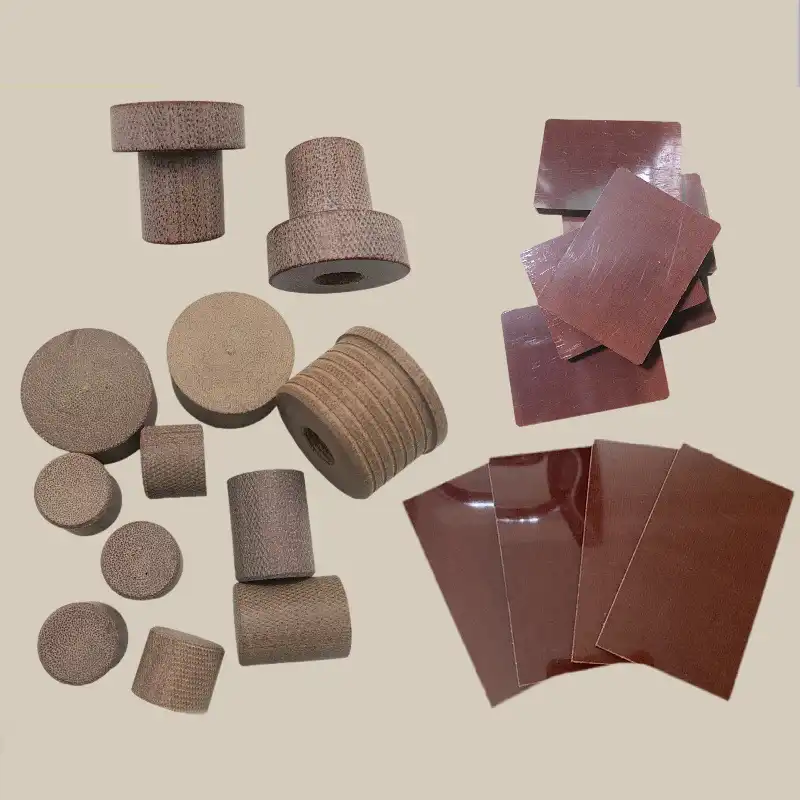
People who make things mix phenolic resin with layers of cotton fabric, heat them up, and then press them together. It's stronger because of the cotton, so it can handle being used. The glue makes the things stronger against electricity and heat. Polyester epoxy and phenolic paper laminate are not cut the same way for this building. You can pull cotton threads out of an edge if the tool is dull, and the glue can get damaged if you use too much heat. How hard it is to cut and how quickly tools wear out rely on the grade, the thickness, the amount of glue, and how long it has been set. Providers should tell me how to machine your part based on its grade and shape, rather than giving me one setting that works for all sheets.
Grades C, CE, L, and LE Compared
ANSI/NEMA LI 1 lists the main types of cotton grades. For Grade C, canvas works well for gears and other parts that get hit hard. For Grade CE, you use canvas that has an electrical formula on it. Cut Grade L linen into small threads and pieces because the weave isn't as tight. The electricity recipe is added to the linen recipe for Grade LE. In order to keep the air dry, the E types are better because cotton soaks up water. You can find grades like C, CE, and L at J&Q. When it comes to strength, cotton types are better than phenolic types. Before you use them, check the humidity level. These materials soak up more water than epoxy polyester.
Match the Grade to Your Operating Conditions
Write down the five things below before you give a grade: power, load, impact, temperature, and humidity. Check the number next to each type of NEMA Phenolic Cotton Sheet to make sure it is close to 130°C (Class B). Gears that are hard to wear out and close to being in the middle are needed for a dry machine. There needs to be an electrical grade on a circuit board in a damp switching room. Parts that sit in transformer oil need laminates that don't stick to mineral oil. Frequency and shape should also be talked about. It's more dangerous to machine things that have thin walls and sharp corners. Then, check your numbers against the service provider's list of numbers and the current rules.
Verify Raw Material and Manufacturing Capability
Documents That Prove Material Identity
What grade do you get? How heavy is it? What lot does the thing come out of? What is the tech sheet information? In what way do you show conformity? Next, check that the number on the paperwork matches the number on the box. For stacked thermosetting materials, ASTM D709 is usually what you should use. To find out how much water something can hold, use ASTM D570 and ASTM D149, respectively. A provider should give the results based on these rules. A license doesn't prove that the part that was made is good, but it does show that the sheet was good to begin with. Also, find out if the supplier is ISO 9001 certified. This is a promise of quality. If you keep track of each batch, it's easier to figure out what went wrong if a part breaks later.
In-House Control Versus Subcontracting
To find out what the provider is in charge of, you need to make the laminate, press it, let it dry, cut it, CNC mill it, check it, and pack it up to send abroad. When these steps are done by a single company, pictures are easier to keep track of since they don't go through as many hands. It can be helpful to hire subcontractors, but it can be tough to communicate with each other. Ask to see the CNC machines, thickness gauges, inspection tools, and units that clean up the dust when you visit or video call. Make sure you have proof of how the measuring tools were set up. Learn more about how the sellers are taught to do many things that are not up to par. This is a better way to show how good something is than making general claims.
What J&Q Brings to Production
For more than 20 years, J&Q New Composite Material Group Co., Ltd has been making insulation materials. For more than 10 years, they have also done business in other countries. NEMA Phenolic Cotton Sheet materials are used to make our JingHong products. Every year, it can hold 13,000 tons of dirt. It can be between 0.5 mm and 100 mm thick, so please call ahead of time to make sure the grade you want is available. It can be made in any size you want, but most people choose 1220 mm x 2020 mm. It can handle a dielectric strength of up to 20 kV/mm, water absorption of less than 2%, a bending strength of 100 to 140 MPa, and a compression strength of 150 to 200 MPa. ISO 9001 says our process is good, and our team helps choose the items we use.
Check Machining Quality Step by Step
Dimensional Checklist
Inspections always happen at the same time if you write them down. Look at the drawing and compare the piece to it in terms of its overall size, thickness, holes, slots, radii, chamfers, smoothness, parallelism, perpendicularity, and concentricity. To measure very small things, you can use calipers, micrometers, pin gages, or a coordinate measuring machine that is very sharp. Transformer plates and spacers need to be flat above all else. The most important thing about joints and gears is that they are concentric. Things with threads, thin walls, countersinks, or corners with small radius are more likely to chip, so be extra careful with those. You should ask for a first-article report with measured values for all dimensions, not just pass marks, if the part is important. You should write down how much time you have before the sale.
Surface and Edge Inspection
The only thing that might be wrong with a part is its edge. Check for cracks, chips, fiber pull-out, burrs, resin burn, and heavy tool marks. If the edges are brown or glazed, it means the tool got too hot. If you see fuzzy fibers, it means the tool is worn out, or the feed rate is off. It's possible for electricity to leak into an electrical part when metal wears away near a cut hole. To make sure everyone understands what "visual acceptance" means, use pictures or a famous piece of art. Sometimes, a case that everyone agrees on is better than a written answer for ending a fight.
Process Control Behind the Final Numbers
Final measurements show one result. It looks at the work of the source to see if they can do it again. Find out these:
• Tooling: Clean cuts and a cool surface are what make CBN tools the best. This keeps the glue safe. Make a note of how long each tool should last, and check it every time you switch it out. People don't notice a tool is worn for a long time until it has burrs, chipped edges, or holes that are too big. Find out what level the tool can handle.
• Cutting parameters: The cutting parameters are the pressure, the speed, the feed rate, and the order of the drill holes. These change the stress and heat of the part. Do they keep an eye on them? Find out from the shop how they set them up for each grade and thickness. If the force is too strong, thin pieces will break. If it's too low, though, they will shake and chip at the edge.
• Dust control: Fine dust is made when NEMA Phenolic Cotton Sheet is cut. Make sure that there is exhaust air, filters, regular cleaning, and gear that is safe for you. Everyone is safer when there is less dust in the air, and finished surfaces stay dust-free, which is important for insulation parts. Check out more than just a picture of the shop floor. Check out how the extraction is set up on the machine.
Clear answers here show that quality comes from a stable process, not luck.
Confirm Performance and Application Fit
Electrical and Mechanical Test Evidence
When they're used, pressed parts still need to work. Based on what you want to use it for, ask for dielectric strength, insulation resistance, breakdown voltage, or arc and tracking resistance. As part of ASTM D149, you can ask for the test direction, the material width, and the preparation. Results for bending, pressing, pressure, strength, and wear may be part of mechanical data. It's not very hard (Rockwell M = 100 to 105), and it can bend more than 15,000 psi (103 MPa) along its length. Pay attention to the facts that have been made public. Real machined parts that will be used for tough jobs, like high-voltage barriers or gears that are loaded, should be tested.
Moisture, Heat, and Chemical Exposure
Cotton soaks up water, so be careful with that. You can find out how much water something takes in over a certain amount of time with ASTM D570. When the air is wet, grades CE and LE keep their dielectric strength better than grades C and L, which absorb more water. Parts can get bigger when they get wet, which can make gaps and tight fits worse. Mineral oil, lubricants, solvents, and weak acids can't hurt phenolic glue. But strong alkalis can damage the NEMA Phenolic Cotton Sheet, so be careful what you clean with. The glue turns into carbon dioxide when the temperature rises too high. This makes it less strong. Also, find out how the seller packs and stores finished goods. If they don't do a good job, the plastic might soak up the water before it gets to you.
Inspection Priorities by Industry
Different fields look at various parts of the picture. Motor and control parts need to have smooth edges, the right amount of holes, and good insulation. This is something that electricians and people who make electronics pay close attention to. Parts that are flat, have the same thickness all the way through, and don't let water in are what buyers in the power field want. People who make machines check how well shafts fit gears, bushings, and spacers, as well as how thick they can go and how long they last. Suppliers to the auto industry focus on making heat-resistant fixtures and insulation pads that can be used over and over again. The people who make appliances work hard to keep costs low, make sure that output stays steady, and get insulation frames and motor parts to customers as soon as they can. Before you ask how much it costs, tell them what you want to use it for. The check plan will be right for the risk this way.
Compare Suppliers and Avoid Costly Mistakes
Build a Supplier Scorecard
Quotes for prices don't always tell the whole story. Score each supplier on how consistent the NEMA Phenolic Cotton Sheet materials are, how many of each kind they have, and how easy it is to machine them. How well do they let you know about tests? How well can they make changes? How long does it take to get it? How well do they pack? How many times have they exported before? How fast can they fix things? When you compare prices, you should make sure that they are all based on the same grade, terms, tests, packing, Incoterms, and so on. When you buy something from a business in the US or China, the most important things are how easy it is and how quickly you get it. J&Q has stores all over the world where they sell things. For our small order of 500 kg, we can take T/T as payment. We pack your order on safe pallets so it can be sent by sea, land, or air.
Follow a Step-by-Step Verification Process
Following a plan can help you save time and money. First, send a full request. This should have the grade, size, plans, tolerances, amount, yearly demand, working conditions, tests, packing, location, scheduling, and anything else you think is important. To help you pick the best suppliers, look at the data sheets, certificates, and inspection reports. Then, make a sample or prototype to check that it fits well, looks good, and has good edges, among other things. Sign off on the first piece in writing. You should know about any changes to the material or process and be able to keep track of each batch as it is made. Checks should be done before and after the process as well. Records should be kept on how many items are returned, how often they are delivered on time, how well they are packed, and how quickly the seller fixes issues after delivery.
Common Buying Mistakes
Most problems with sourcing are caused by a vague definition, not bad intentions. People make the first mistake when they choose a grade based only on price. This can lead to problems with the heat, electricity, or machinery. The second mistake is thinking that all NEMA Phenolic Cotton Sheets are stable, have the same amount of resin, and are woven and finished the same way. It's also not smart to believe a proof of material without seeing the final items. The fourth step is to not worry about how smooth the surface is. The fifth step doesn't wait for the prototype to be approved. This is the sixth problem: bad storage. When you stack laminate without any support, water, pressure, heat, and dirt should stay away from it. These holes can be filled to fix a lot of the things that cause lots to be turned down.
Conclusion
People who sell NEMA Phenolic Cotton Sheets have to show proof at all times to make sure they do a good job. That's why the grade needs to meet the requirements for power, load, moisture, and temperature. There are differences between how grades C, CE, L, and LE act. It is easy to keep track of production, and records are kept for each lot. This proves that the method and stuff are known. If the provider checks the tools and dust sizes, edges, and safety, they can get the same result again. The ASTM D709, D149, and D570 tests show that the product does what it's supposed to do. Each business should decide how important these checks are based on what they are used for. You can do these checks over and over again with sample approval, first-article reports, and a grade. Less time is wasted, work is done again, and parts are sent back.
FAQ
What documents should I request before approving a supplier?
Ask for the grade, lot number, data sheet, and test proof if it's for your batch. Put the number of each lot on the right bin. Checklists and records of the quality system, like ISO 9001 approval, should also be there.
Which tools work best for machining phenolic cotton laminate?
For sure, you should use tools made of carbide for machining NEMA Phenolic Cotton Sheet. They cut well and keep the glue from getting too hot. High-speed steel can be used, but it breaks down faster. In either case, clean up the mess and ask the shop to show you proof that it checks its tools before changing them.
Do I need a prototype before a production order?
Especially for parts that are made just for you, yes. With a sample and a first-article report, you can find issues with fit, edge, and tolerance before you have to make a lot of them. Write down that you're happy with the outcome.
How does moisture affect cotton-based laminate?
Epoxy fiberglass doesn't soak up water as well as cotton does. If it's going to be wet, choose CE or LE grades because water can make parts expand, which lowers the breakdown voltage. Find out how the seller stores and packs sheets.
Request a Technical Review and Sample Quote from J&Q
Send J&Q your drawings along with the NEMA Phenolic Cotton Sheet grades you want, how much you want, and where you want the goods sent. After that, your job will be reviewed by our team. We have been making these materials for a long time. Our company is ISO 9001-approved, and each year we can make 13,000 tons of sheets. We can handle everything for you because we have our own logistics company. Send an email to info@jhd-material.com to get a price and a professional review. Go to blog.jhd-material.com to learn more.
References
1. NEMA LI 1 Industrial Laminated Thermosetting Products, National Electrical Manufacturers Association, 1998
2. ASTM D709 Standard Specification for Laminated Thermosetting Materials, ASTM International, 2017
3. ASTM D149 Dielectric Breakdown Voltage and Dielectric Strength Test Method, ASTM International, 2020
4. ASTM D570 Standard Test Method for Water Absorption of Plastics, ASTM International, 2018
5. ISO 9001 Quality Management Systems Requirements, International Organization for Standardization, 2015
6. Handbook of Thermoset Plastics, Elsevier, 2014

Get a complete product list and quotation
J&Q New Composite Materials Company