How Does CNC Machining Improve 94V0 FR4 Fiberglass Sheet Accuracy?
CNC machining significantly improves 94V0 FR4 fiberglass sheet accuracy through automated, programmable toolpaths that eliminate human error and achieve tolerances as tight as ±0.05mm. Unlike manual routing or conventional cutting methods prone to warping and chipping, CNC technology controls spindle speed, feed rate, and cutting depth with precision, preventing delamination and fiber pull-out. The computerized process maintains consistent dimensional stability across production batches, ensuring repeatable quality essential for PCB substrates, high-voltage switchgear insulation, and automotive components where even minor deviations compromise electrical performance and safety compliance.
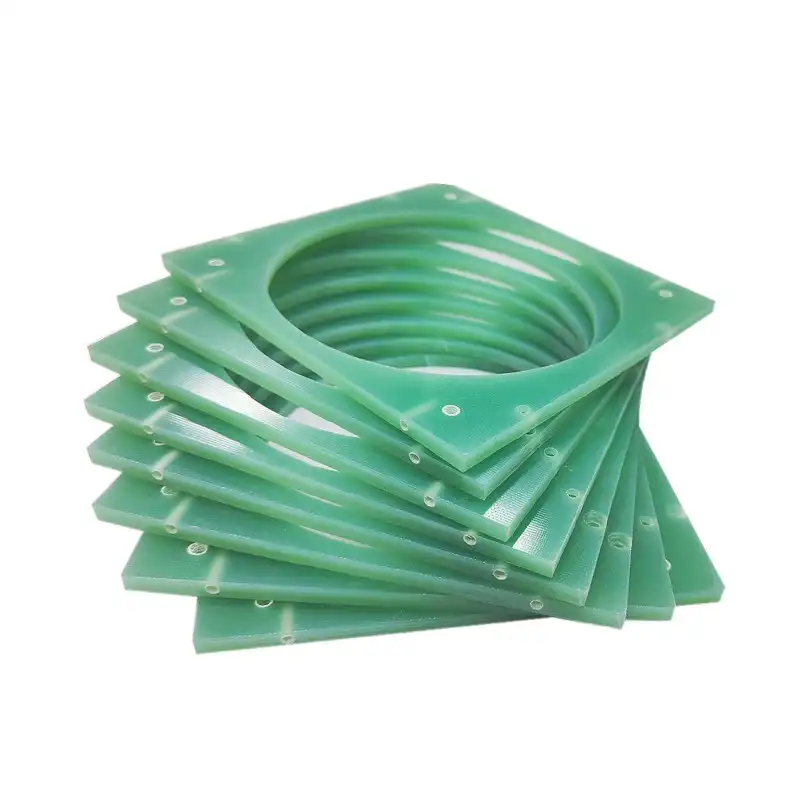
Understanding the Accuracy Challenges of 94V0 FR4 Fiberglass Sheets
When you work with flame-resistant epoxy laminates, you need to pay close attention to every detail. The combined nature of these materials makes it hard to use traditional machining methods, which creates problems that affect how well the end product works.
Material Composition Complexity Creates Precision Barriers
When woven fiberglass cloth and brominated epoxy resin are mixed, they make machining very difficult. The glass strands have a mechanical strength of over 340 MPa, but they also make the material rough, which means that regular cutting tools get dull very quickly. As tooling wears down during production runs, this roughness causes edge quality to vary and dimensions to shift. Because manual workers can't account for these slow changes, parts start out within tolerance but end up outside of allowed ranges.
Thermal and Mechanical Stress During Processing
When you cut with a regular blade, you create localized heat that changes the Glass Transition Temperature zone of the material. This is especially problematic when working with 94V0 FR4 Fiberglass Sheet, as standard-grade sheets are close to 130°C. During machining, thermal expansion causes short-term dimensional changes that can become permanent flaws when the material cools down. Although the material's dielectric properties make it suitable for electrical protection with a breakdown voltage above 40kV, they also make it vulnerable to mechanical stress patterns during cutting. Handheld routers and unstable fixtures can cause invisible micro-cracks that negatively affect long-term stability in high-voltage applications such as transformer barriers and busbar supports.
Tolerance Deviation Impact on Critical Applications
For proper component seating and soldering contact, electronic assemblies need PCB substrates that are all the same thickness, plus or minus 0.1 mm. To keep catastrophic arcing faults from happening, power distribution equipment needs arc shields to stay flat and meet specifications for less than 0.5% warpage. When standard methods make parts that aren't within these ranges, makers have to deal with high rejection rates, production delays, and the chance of failures in the field. More and more, engineering managers and procurement experts are realizing that these hidden costs are higher than the savings that come from using cheaper methods of processing.
How CNC Machining Addresses and Enhances Accuracy in 94V0 FR4 Fiberglass Sheet Processing
The way these difficult composite materials are worked with in business is changing because of computer-controlled production. The technology makes quality better in a number of ways that can be measured.
Programmable Precision Eliminates Human Variability
Optimized Cutting Parameters Prevent Thermal Damage
Modern CNC machining centers let you precisely control spindle speeds between 12,000 and 24,000 RPM, so you can match them to the shape of the tool and the condition of the material. Higher speeds and lighter cuts cut down on the dwell time that builds up heat, which keeps the dimensions stable during the cutting process. Integrated cooling systems direct the cutting fluid right where the tool meets the material. This gets rid of heat and glass dust that could affect accuracy otherwise. Too much tool pressure, which happens when hand workers push too hard to meet production goals, can damage the epoxy layers. Feed rates that are adjusted to the density of the material stop this from happening.
Comparative Performance Data Demonstrates Clear Advantages
These benefits can be measured and directly relate to buying value. Mechanical experts who make gears and spacers can be sure that they will be able to hold loads when thickness limits stay the same. Research and development teams that make barriers for battery packs can reliably protect them from heat when they make sure the barriers fit correctly within the tight packing rules for cars.
Selecting the Right 94V0 FR4 Fiberglass Sheet & CNC Machining Services for Your Project
For buying to go well, material requirements must be matched with application needs, and service providers must be checked for technical competence.
Material Grade Selection Based on Operating Environment
The UL 94 V-0 grade means that the fire will go out on its own in 10 seconds during vertical burn testing, but procurement workers need to look at other requirements as well. Standard sheets with a Tg of about 130°C are good for most electronics uses. High-Tg versions, rated to 180°C, can handle soldering pallet environments where the temperature changes a lot. The dielectric strength requirements, which are usually 50 kV/mm, should match the voltages used in power distribution systems. Chemical resistance is important for things that will be cleaned with solvents or used in industrial settings. According to ASTM D570, electrical properties stay fixed in humid circumstances if water absorption rates are less than 0.2%. However, for high-frequency uses, moisture uptake rates may need to be even lower.
Evaluating CNC Service Provider Capabilities
Suppliers you can trust give you full material datasheets that list the mechanical, electrical, and thermal qualities of the material along with test method references. They sell OEM-grade goods that meet ROHS environmental standards, which are becoming more and more important in foreign markets. Some forward-thinking companies make eco-friendly versions with flame retardants that don't contain halogens. These products support companies' efforts to be more environmentally friendly without lowering the safety standards.
Building Strategic Supplier Relationships
Cost and Procurement Considerations When Combining CNC Machining with 94V0 FR4 Fiberglass Sheets
To make smart purchases on a budget, you need to know the total cost of ownership (TCO) instead of just comparing price quotes.
Pricing Structure Components
The cost of base materials depends on the grade, the thickness of the sheet, and the size of the order. Because of changes in how the plastic is made, standard sheets usually cost less than high-Tg versions. When you order custom sizes, there are setup fees that go down as the number of units you buy goes up. This makes large agreements a good option for stable production needs. Some of the costs that come with CNC machines are the time it takes to design complicated shapes, the cost of tools that is spread out over many production runs, and machine-hour rates that show how complex the equipment is. Rush fees are applied when faster shipping cuts down on standard lead times. However, if you have a good relationship with your supplier, they may be able to be flexible in an emergency.
Total Value Analysis Beyond Initial Pricing
The overall value of CNC machining is often higher because it reduces waste and ensures consistent quality. Precision cutting reduces the amount of scrap from measurement mistakes, which protects the expensive materials that were used. When the number of defects goes down, there is less work to do again, and there are no delays that throw off production schedules. Consistent accuracy lowers the workload of new inspections, which frees up quality resources to work on other things. Field reliability improvements lower warranty costs and protect a brand's image. This is especially important in automobile and aerospace uses where safety issues carry huge liability risks.
Logistics and Support Infrastructure
When managing global supply chains that go through different regulatory jurisdictions or coordinating manufacturing operations that happen in more than one location, these logistical factors become even more important.
Future Trends and Innovations: CNC Machining's Role in Advancing 94V0 FR4 Fiberglass Sheet Applications
Manufacturing technology is always changing, adding new features that make things more precise and give them more uses.
Adaptive Machining and Real-Time Quality Monitoring
New CNC systems have sensors that measure cutting forces and vibration patterns. When tool wear or material changes are noticed, the parameters are instantly changed. This adaptive control keeps the accuracy the same over long production runs without any help from an assistant. In-process measurement systems check important dimensions while machining, finding mistakes before the parts are finished and letting them be fixed right away. Monitoring in real time creates lines of data that are fed into statistical process control systems. These systems find trends before they lead to quality problems.
Industry 4.0 Integration and Smart Manufacturing
Connected CNC equipment talks to enterprise resource planning systems, which enables real-time visibility into production progress and allows schedules to be adjusted based on actual capacity availability. For manufacturers producing 94V0 FR4 Fiberglass Sheet, machine performance data can be integrated with predictive maintenance algorithms to schedule tool replacements and preventive services before equipment failures occur, significantly reducing unplanned downtime. Digital twin technology further allows engineers to optimize virtual production processes before physical manufacturing begins, shortening prototype development cycles and lowering the cost of scaling production. These smart manufacturing capabilities are especially valuable in high-mix, low-volume production environments, such as those used for customized electronic components and specialized industrial equipment.
Expanding Application Horizons
Flame-resistant laminates can be used in new ways in tough environments thanks to improved CNC precision. The good strength-to-weight ratio and fire safety approval for electrical enclosures and internal parts are used in aerospace applications. For the best cell spacing and cooling, electric vehicle battery systems need complex thermal management barriers that are machined to very close tolerances. Next-generation telecommunications infrastructure needs shielding materials that can meet strict dielectric performance requirements at higher frequencies and keep their shape even when exposed to external stress. V-0 rated materials are becoming more and more required in building electrical systems, public infrastructure projects, and mass transit because of rules meant to make them safer in case of fire.
Conclusion
When working with flame-retardant epoxy laminates such as 94V0 FR4 Fiberglass Sheet, CNC cutting completely changes the accuracy of results. Programmable accuracy, optimized cutting settings, and steady repeatability that human methods can't match are some of the ways that this technology solves problems that come with working with certain materials. When procurement professionals choose CNC-processed materials, they get measurable benefits in terms of dimensional tolerance, defect reduction, and total cost of ownership. To do good buying, you need to compare the specs of the materials you want to use with the needs of your project and check out service providers to make sure they have the right technical skills, quality systems, and practical dependability. As adaptable control and smart factory integration become more common in production technology, CNC machining will be able to be used in more complex ways that combine electrical safety, fire safety, and mechanical accuracy. Companies that form strategic relationships with experienced providers can take advantage of these new skills and keep their competitive edge in markets that care a lot about quality.
FAQ
What tolerances can CNC machining achieve with FR4 laminates?
When working with epoxy-glass composites, modern CNC machines usually keep ±0.05mm to ±0.1mm errors on important measurements. Actual accuracy varies on the shape of the part, the thickness of the material, and the form of the fixture. For complicated three-dimensional shapes, the specs may need to be loosened a bit, but for simple profile cuts, they can be made with more precision. Talking about specific needs with your machining partner during the quotation phase helps you set reasonable goals and plan the right process.
How does CNC processing affect the UL 94 V-0 rating?
When done right, CNC machining doesn't change the flame-retardant properties of certified materials. The V-0 grade comes from the chemistry of the epoxy resin throughout the whole object, not just the surface. Cutting reveals new material that is just as resistant to fire. Performance could be affected by contamination from using the wrong coolants or doing additional processing afterward, so following clean handling procedures protects the accuracy of safety certification.
Can CNC machining handle both prototypes and production volumes?
The CNC technology works well for all order sizes. Programming freedom lets design changes happen during trial stages without having to buy expensive tools. Once the designs are finalized, the same digital files are used to run production. This makes sure that prototypes are exact copies of production parts. For small amounts, setup time makes up a bigger part of the total cost, but the benefits of accuracy and predictability often make it worth it, even for short runs in serious situations.
What lead times should procurement teams expect?
Depending on the difficulty of the order, the supply of materials, and the shop's capacity, lead times are usually between one and three weeks. Standard-grade sheets in common sizes generally ship faster than specialty sheets that need to be ordered in advance. Geometries that are complicated and have tight tolerances take longer to write and set up. There are shorter wait times for rush services, but they cost more. Setting up blanket buy deals with planned releases is a good way to keep track of lead times for ongoing production needs.
Partner with J&Q for Precision-Machined 94V0 FR4 Fiberglass Sheet Solutions
For your flame-retardant laminate needs, J&Q has more than twenty years of experience making things and more than ten years of experience trading internationally. As a well-known company that sells 94V0 FR4 Fiberglass Sheet, we use advanced CNC processing and in-house production control to make sure that your applications get the exact measurements they need. Our expert team knows how to deal with the unique problems that electrical and electronics manufacturers, machinery builders, power transfer companies, car suppliers, and appliance makers face. We have strict quality systems that make sure we follow UL/ROHS rules and get the same performance from batch to batch. Our integrated logistics company offers streamlined one-stop service from choosing materials to delivering them, so you don't have to deal with the coordination issues that come up when you buy from multiple vendors. Engineering managers and procurement experts get a strategic partner who cares about their success and is willing to communicate openly and offer technical help throughout the lifecycle of a project. Get in touch with us at info@jhd-material.com to talk about your specific needs and find out how precision-machined insulation materials can improve the performance of your products and make your manufacturing process more efficient.
References
1. Harper, C.A. (2006). Electronic Materials and Processes Handbook, Third Edition. McGraw-Hill Professional.
2. Coombs, C.F. (2008). Printed Circuits Handbook, Sixth Edition. McGraw-Hill Education.
3. Society of Plastics Engineers. (2012). Plastics Technician's Toolbox: The Basic Elements of Plastics Technology. SPE Books.
4. Underwriters Laboratories. (2013). UL 94: Standard for Safety of Flammability of Plastic Materials for Parts in Devices and Appliances. UL Standards.
5. IPC Association Connecting Electronics Industries. (2016). IPC-4101: Specification for Base Materials for Rigid and Multilayer Printed Boards. IPC Publications.
6. Groover, M.P. (2020). Fundamentals of Modern Manufacturing: Materials, Processes, and Systems, Seventh Edition. Wiley Publishing.

Get a complete product list and quotation

J&Q New Composite Materials Company