FR4 G10 Epoxy Resin Rod Provides High Strength Support for Electrical Assemblies
When engineering teams need a structural insulator that performs consistently under electrical stress, mechanical load, and thermal cycling, the FR4 G10 epoxy resin rod stands out as a dependable choice. Built from woven glass fabric bonded with epoxy resin and processed under high heat and pressure, this rod type delivers dielectric strength ≥ 40 kV/mm, flexural strength ≥ 450 MPa, and continuous heat resistance up to 130°C — all in a single, machinable form factor. For B2B procurement teams in electronics manufacturing, power distribution, and industrial machinery, understanding this material's real capabilities helps eliminate costly specification errors before sourcing begins.
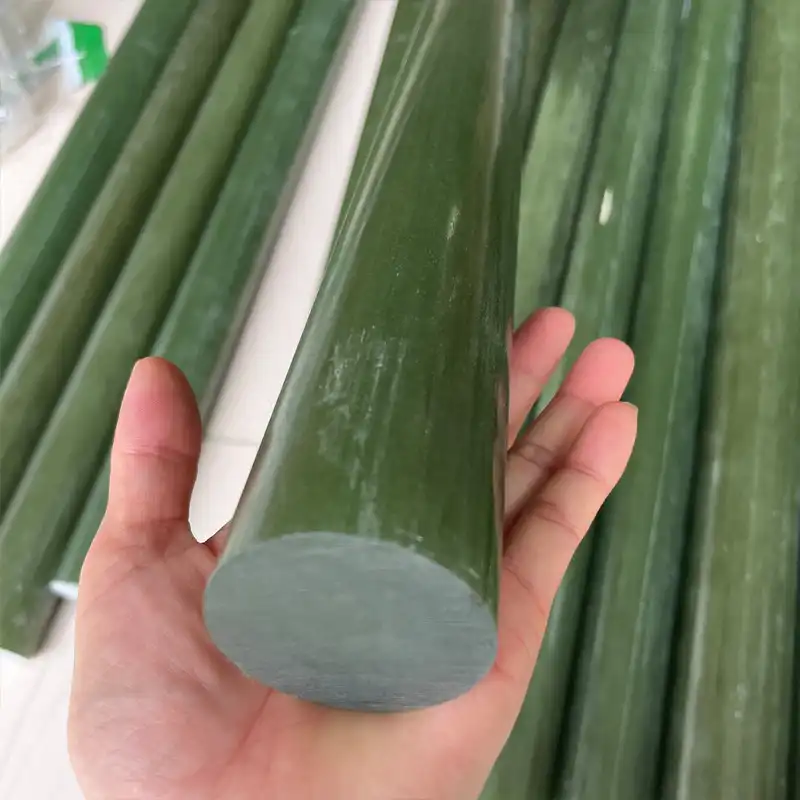
Understanding FR4 G10 Epoxy Resin Rods: Composition and Core Properties
What the Material Is Made Of
The continuous-filament woven glass cloth is mixed with an epoxy resin binder to make FR4 G10 fiberglass rods. The stacked structure is then laminated and cured under controlled pressure and temperature. The end result is a thick, void-free stick that absorbs almost no water (≤ 0.1%) and has a density between 1.7 and 1.9 g/cm³. These physical features directly affect how well the rod works in places that are prone to wetness or chemicals that are harsh.
The Technical Distinction Between FR4 and G10
The G10 standard sets the minimum level of mechanical strength and electrical insulation for glass-epoxy laminates. FR4 builds on that base by adding flame-retardant chemicals based on bromine. This makes it able to meet the UL94 V-0 flammability classification, which means it goes out on its own 10 seconds after being lit. To meet fire safety standards, engineering teams that need to define parts for enclosed switchgear, transformer systems, or PCB support structures usually need FR4 grade. G10 can still be used for structural or low-combustion-risk uses where fire resistance is not the most important thing.
Key Performance Parameters
The Fr4 G10 Epoxy Resin Rod has a Rockwell hardness of M100–M110, which helps it resist wear during repeated mechanical contact. Under standard-grade conditions, Fr4 G10 Epoxy Resin Rod can operate across a temperature range of approximately -50°C to +130°C. For applications involving higher thermal demands, high-Tg versions such as Tg150 and Tg170 can provide improved thermal capability and greater temperature resistance. When evaluating Fr4 G10 Epoxy Resin Rod suppliers, procurement teams should compare the offered material specifications with applicable standards such as NEMA FR-4/G-10, ASTM D709, and MIL-I-24768/27 (Type GEE-F), while also confirming the exact grade and test methods used. A supplier that provides complete technical documentation for Fr4 G10 Epoxy Resin Rod can make it easier for engineering teams to verify hardness, operating temperature, and thermal performance before purchasing. For demanding applications, selecting the appropriate Fr4 G10 Epoxy Resin Rod grade according to the required operating conditions can help ensure consistent material performance.
Comparison and Rational Selection of Epoxy Resin Rods for Electrical Applications
FR4 G10 vs. Phenolic Cotton Rods
Although phenolic cotton rods are cheaper and easier to work with, they absorb a lot more water than glass-epoxy rods, which makes them less effective as dielectrics in damp places. FR4 G10 fiberglass rods keep their electrical resistance even after being exposed to water for a long time. This makes them the best choice for high-voltage insulation or sites that are near water or outdoors, where phenolic materials would break down over time.
FR4 G10 vs. Standard Fiberglass Rods
It's not true that all fiberglass rods are fire-resistant. Standard fiberglass materials might pass mechanical tests but fail UL94 V-0 tests. If you choose a rod that hasn't been confirmed to be FR4 for use in electrical panels, motor housings, or any other setup where there is a risk of an ignition, you'll be breaking the rules. Before accepting a material for use in production, procurement teams should always ask suppliers for proof of UL approval.
Selecting the Right Grade for Your Assembly
The following factors help most people decide which rod type to buy when they are deciding between them. Here are the main factors that tech teams use to choose candidates:
- FR4 grade — Required when UL94 V-0 flammability compliance, dielectric strength ≥ 40 kV/mm, and enclosed-assembly fire safety codes all apply simultaneously.
- G10 grade — Appropriate for structural mechanical spacers, wear bushings, or fixtures where fire-retardant certification is not a specification requirement.
- High-Tg FR4 — Selected for assemblies operating above 130°C continuously, such as power transformer components or automotive battery pack barriers.
These differences keep people from specifying the material too much or too little, which has a direct effect on both the reliability of the product and the cost-effectiveness of procurement.
Practical Uses and Application Scenarios in Electrical Assemblies
Switchgear and High-Voltage Power Components
Arc barriers and standoff insulators in high-voltage switchgear are put under both mechanical stress and electrical arcing events. Epoxy fiberglass rods don't track, which is when conductive carbon paths form along a surface when an arc is exposed to it. This makes them a useful building material in these conditions. Power distribution engineers often use them as phase barriers in medium-voltage panels because the material doesn't turn to carbon when it comes into short-term contact with a spark.
PCB Assembly Fixtures and Structural Support Rods
Fr4 G10 Epoxy Resin Rod is commonly used as guide pins, drilling tools, and mechanical supports in assembly fixtures used by PCB manufacturers and electronics OEMs. The dimensional stability of Fr4 G10 Epoxy Resin Rod helps maintain fixture geometry during repeated production cycles, while its relatively stable thermal expansion behavior can reduce unwanted movement as temperatures change. In automated and precision assembly environments, Fr4 G10 Epoxy Resin Rod can help fixtures maintain consistent positioning when tight positional tolerances are required. This dimensional consistency can reduce alignment errors and support more repeatable production results. For PCB and electronics manufacturing teams, selecting Fr4 G10 Epoxy Resin Rod for fixture components can provide a useful combination of rigidity, machinability, electrical insulation, and dimensional stability. These characteristics make Fr4 G10 Epoxy Resin Rod a practical material option for guide components and mechanical supports used in demanding production-line fixtures.
Industrial Machinery and Automotive Applications
FR4 fiberglass bars are cut by machinery makers into wear-resistant bushings, insulating spacers, and parts that fit next to gears. The same material is used as a barrier between cell groups in automotive battery assemblies. Its ability to stay stable in temperature and low water absorption during charge-discharge cycling are direct performance requirements. To keep up with changing safety standards for electric vehicles, Tier-1 automakers in the U.S. market are asking for more and more FR4-grade insulation parts.
Procurement Guide: How to Source Quality FR4 G10 Epoxy Resin Rods for Your Projects
Certifications and Standards to Verify
Any company that sells epoxy fiberglass insulation rods should have quality management certifications that can be checked. ISO 9001 confirms that the production process is being controlled; ISO 14001 talks about managing the environment; and ISO 45001 talks about health and safety at work. In addition to management methods, the rod itself should meet ASTM D709 or a foreign standard that is similar. For uses in the U.S. market, most buyers in the electronics and power sectors must have proof of UL certification and RoHS compliance.
Ordering Parameters and Customization Options
J&Q offers Fr4 G10 Epoxy Resin Rods with diameters from φ5 mm to φ2000 mm through its manufacturing partner Jinghong, which opened in 2018 and has a 36,300 m² facility that can make up to 100 tons of rod products every year. The standard rod length is 1 meter. It's a light green color itself. For OEM needs, we can make profiles, diameters, and lengths that aren't standard. Shipping by ocean, land, or air freight is flexible enough to handle both large orders and urgent deliveries for a single project.
Evaluating Supplier Reliability for Long-Term Sourcing
Supplier track record is just as important as product specification sheets. J&Q has been making insulating materials for more than 20 years and has worked with distributors and makers all over North America for more than 10 years in busy foreign trade partnerships. The company also runs its own logistics arm, which means that from production to delivery, everything comes from a single source. This is a big benefit for procurement managers who have to manage complicated supply chains.
Conclusion
Few insulating materials combine electrical, mechanical, thermal, and flame-resistant properties as effectively as Fr4 G10 Epoxy Resin Rod. With high dielectric strength, low moisture absorption, mechanical rigidity, and machinability, Fr4 G10 Epoxy Resin Rod can provide reliable insulation performance for demanding industrial applications. Selecting the appropriate grade from a certified and experienced supplier of Fr4 G10 Epoxy Resin Rod can help engineering and procurement teams reduce technical and supply-chain risks across the automotive, electrical manufacturing, power distribution, and industrial machinery sectors. J&Q can support both one-time project requirements and long-term supply programs for Fr4 G10 Epoxy Resin Rod, backed by product documentation, production capacity, and logistics capabilities. For buyers seeking consistent material quality and dependable delivery, Fr4 G10 Epoxy Resin Rod provides a practical insulation solution for a wide range of engineered components.
FAQ
What Is the Continuous Operating Temperature of These Rods?
Standard FR4 G10 rods can be used continuously at 130°C (Class B/F). High-Tg versions are offered at Tg150 and Tg170 for uses that need to be able to handle higher temperatures, like power transformer coils or tough battery conditions in cars.
Can the Rods Be Machined With Standard Shop Equipment?
Not at all. For CNC turning, drilling, and milling, carbide or diamond-tipped tools are needed because glass fibers are very rough. OSHA rules say that fiberglass dust is dangerous to your health, so you need to make sure that enough dust is removed. To cut down on tool wear in-house, most precision-grade sources can offer parts that have already been made.
How Does FR4 G10 Perform in Humid or Wet Environments?
According to ASTM D570, water absorption stays at or below 0.1% after 24 hours of soaking. This means that electrical resistance and physical stability don't change much in high-humidity conditions. This means that the material can be used for industrial equipment that is close to water and outdoor power distribution areas where tight seals aren't always possible.
Does the Material Conduct Electricity?
Electricity can't flow through FR4 G10. If a rod's surface conducts electricity, it either has metallic bits on it or is an ESD-specific type that has carbon added on purpose. Standard procurement should always ask for a non-conductive grade, unless the design calls for ESD dissipation.
What Certifications Should I Request From a Supplier?
At the very least, ask for test results for ISO 9001, ISO 14001, UL94 V-0, RoHS compliance, and ASTM D709 compliance. You might also need MIL-I-24768/27 compliance records for U.S. defense or aircraft projects.
Get FR4 G10 Epoxy Resin Rods From a Trusted Supplier — Contact J&Q Today
All over the United States, makers, OEMs, and buying teams can get approved Fr4 G10 Epoxy Resin Rods from J&Q. We make sourcing easy by producing with ISO-certified methods, offering diameters from ±5 mm to 2000 mm, a range of shipping options, and dedicated technical support. We are a well-known FR4 G10 Epoxy Resin Rod maker with more than 20 years of experience. We can offer samples, data sheets, and prices for large orders. Email us at info@jhd-material.com or go to blog.jhd-material.com to get in touch with us.
References
1. ASTM International. ASTM D709: Standard Specification for Laminated Thermosetting Materials. ASTM International, 2021.
2. National Electrical Manufacturers Association (NEMA). NEMA LI 1: Industrial Laminating Thermosetting Products. NEMA, 2020.
3. Underwriters Laboratories (UL). UL 94: Standard for Tests for Flammability of Plastic Materials for Parts in Devices and Appliances. UL, 2018.
4. Harper, C. A. Handbook of Plastics Technologies. McGraw-Hill, 2006.
5. Sanjay, M. R., et al. "A Review of Properties and Applications of Glass Fiber Reinforced Polymer Composites." Journal of Reinforced Plastics and Composites, 2018.
6. IPC — Association Connecting Electronics Industries. IPC-4101: Specification for Base Materials for Rigid and Multilayer Printed Boards. IPC, 2017.

Get a complete product list and quotation

J&Q New Composite Materials Company



