Epoxy Fiberglass Tube for High Voltage Electrical Insulation Systems
When engineers and procurement managers search for reliable insulation solutions in high-voltage environments, one material consistently rises to the top of the shortlist. The epoxy fiberglass tube — manufactured from alkali-free glass cloth impregnated with epoxy phenolic resin through hot rolling and baking — delivers a rare combination of dielectric strength, thermal stability, and structural rigidity. Whether you are designing switchgear assemblies, transformer coil supports, or arc barrier components, understanding this material thoroughly can significantly reduce system failures and lifecycle costs.
Understanding Epoxy Fiberglass Tubes in Electrical Insulation
What Makes This Composite Material Unique?
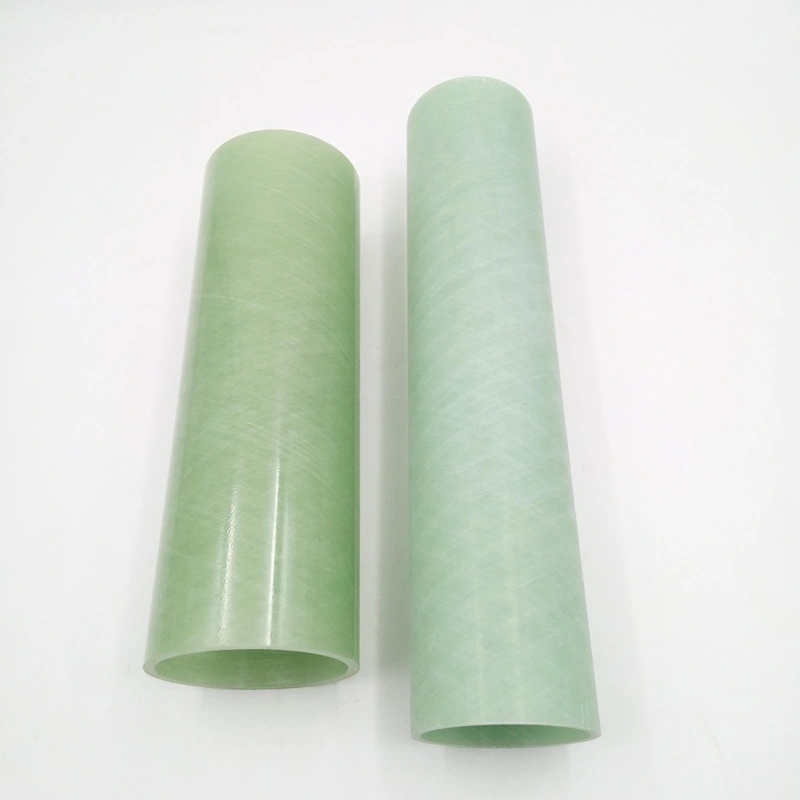
A thermoset laminate combination is what an Epoxy Fiberglass Tube is at its core. The structure is held together by alkali-free glass fabric, and the layers are held together by an epoxy-phenolic resin matrix that is resistant to chemicals, stable in shape, and very good at conducting electricity. This makes a tube that doesn't let water in, keeps its shape when temperatures change, and can be submerged in transformer oil, which is something that many other insulators can't say.
J&Q's product line has a unique green finish and inner sizes ranging from ʆ8mm to φ550mm. It can be used in a lot of different industry setups. There are no blisters on the surface, and only small wrinkles are allowed within the wall thickness limits. This is a precise standard that is important for fitting tight-clearance parts.
Key Technical Performance Data
Lab tests that have been confirmed for the 3640-grade epoxy tube show:
- Density: 1.70 g/cm³ (requirement ≥1.65)
- Vertical layer electrical strength (90°C in oil): 8 MV/m
- Insulation resistance (normal condition): 5.5×10¹² Ω
- Volume resistivity: 2.4×10¹³ Ω·m
- Thermal stability at 150°C/24h: No cracking or bulging observed
These numbers show how Epoxy Fiberglass Tube things actually work, not how well they should work in theory. This gives buying teams accurate information for specification papers.
Comparing Epoxy Fiberglass Tubes with Alternative Materials for Electrical Insulation
How It Stacks Up Against PVC, Metal, and Carbon Fiber?
To pick the right insulation tube, you need to compare them fairly. There are pros and cons to each type of material that become very important when working at high voltages.
While PVC tubing is cheap and easy to work with, its highest continuous service temperature rarely goes above 80°C. This means it can't be used for transformer enclosures or motor parts that normally work at 120°C to 150°C. Steel or metal conduit makes structures stronger, but it also adds a lot of weight, increases the risk of galvanic corrosion, and, most importantly, it conducts electricity instead of stopping it.
The mechanical strength-to-weight ratio of carbon fiber tubes is very high, but they conduct electricity very well, which means they can't be used as high-voltage shielding. Over time, glass fiber tubes that don't have an epoxy matrix can soak up water, which makes them less effective at insulating.
The Epoxy Fiberglass Tube does a good job of balancing these trade-offs. It's about a quarter the weight of similar steel tubing, doesn't suffer from galvanic corrosion, can work at temperatures up to 150°C, and has volume resistivity values higher than 10±± ©·m. When purchasing managers look at the total cost of ownership over a 10–15 year service horizon, these features directly mean fewer replacements and lower costs for maintenance labor.
Why Epoxy Fiberglass Tubes Are Ideal for High Voltage Electrical Insulation Systems?
Proven Performance Across Demanding Sectors
Engineers choose Epoxy Fiberglass Tubes for high-voltage systems because of more than just their individual property scores. It's how those properties work together when they are stressed at the same time. In a transformer, the tube has to be able to withstand partial discharge, be submerged in hot oil, and keep its shape over thousands of temperature cycles. A single-property answer doesn't work here, but a multi-property laminate blend does.
Here are the main performance benefits of this material that make it a good choice:
- Superior dielectric isolation: With a vertical electrical strength of 8 MV/m in oil at 90°C, the material resists dielectric breakdown even in thermally stressed conditions — a direct safety benefit in power distribution cabinets and switchgear.
- Chemical resilience: The cured epoxy matrix resists alkalis, acids, and solvents, making it compatible with coolant oils, cleaning agents, and humid industrial atmospheres without surface tracking or degradation.
- Structural integrity under load: The glass fiber reinforcement provides mechanical rigidity sufficient for use as coil formers, arc barriers, and structural spacers in both dry-type and oil-immersed transformers.
- Moisture resistance: The combination of low water absorption (≤0.6%) and stable insulation resistance after immersion makes this material dependable in humid climates and wash-down environments.
Together, these benefits cut down on unplanned downtime, which is a real financial factor for companies that run power distribution networks and industrial OEMs that are in charge of large fleets of equipment. Beyond the performance of each individual part, the overall effect on system uptime and repair intervals makes the material choice worthwhile, even if it costs more up front than simpler options.
How to Choose and Procure the Best Epoxy Fiberglass Tube for Your Needs?
Technical and Commercial Criteria for B2B Buyers
Choosing the right Epoxy Fiberglass Tube insulation tube starts with choosing the voltage class. Buyers should make sure they know what the needed dielectric strength is at the working temperature, not at room temperature, because as temperature rises, insulation resistance decreases. It's also important to know the thermal class. Systems that run constantly at 130°C or higher need materials that have been tried under long-term thermal loading, not just short-term exposure.
It is just as important for electrical efficiency as it is for dimensional accuracy. When coil winding, where gaps in the insulation can lead to partial discharge, it's important to have tight inner diameter tolerances. Not just general datasheet values, but also mill test certificates and test results that are specific to each batch.
When it comes to business, evaluating a possible Epoxy Fiberglass Tube supplier is more than just looking at prices. Some of the most important things to look at are the yearly production capacity, the quality management certification, the ability to customize, and the transportation infrastructure. With a plant that can make 43,000 tons of insulation material a year and more than 20 years of experience, J&Q is able to maintain fully automatic production lines that keep consistency from batch to batch. J&Q offers one-stop service from production scheduling to final delivery, thanks to a combined logistics operation that handles ocean, land, and air freight. This is a big help when handling tight project deadlines.
Installation Tips and Best Practices for Epoxy Fiberglass Tubes in High Voltage Systems
Handling, Fitting, and Long-Term Maintenance
When a part is installed correctly, it protects both the part and the system it works with. Lay the tubes out flat on padded racks in a dry, well-ventilated space that is out of direct sunlight and away from chemical vapors. Do not stack tubes without using safe gaps, as surface wear and tear can cause tiny cracks that weaken the insulation over time.
To keep the edges from delaminating, use cutting tools with carbide tips and keep the feed rate low while fitting. Clean the cut surfaces with dry compressed air after cutting and before putting them together. Metal bits on contaminated surfaces can make conductive paths in high-voltage areas.
Visual checks for surface tracking marks, discoloration from thermal stress, or mechanical impact damage should be part of a regular inspection. If you use a tube that is submerged in oil and sees signs of growth or resin split, you should replace it. By doing these things, you can extend the system's useful life and keep its integrity, which is why you spent the money on it in the first place.
Conclusion
Epoxy Fiberglass Tubes have won their place in high-voltage electrical shielding because they can handle multiple failure modes at once. Their dielectric performance, thermal resilience, chemical stability, and structural integrity are all combined into a single, machineable part that can be used in demanding situations in industrial machinery, electric vehicle charging, motor manufacturing, and power distribution. This blend is still a good, evidence-based choice for engineering managers and procurement teams that need reliable insulation materials with checked scientific data and a supply that can be scaled up.
FAQ
Why do epoxy fiberglass tubes outperform traditional ceramic or PVC insulators in high-voltage systems?
Ceramic barriers are heavy and easily broken, so they can't be used in places where vibrations are common. PVC can't handle the temperatures that are typical in transformer and switchgear uses. Epoxy Fiberglass Tubes are made of a single material that has high dielectric strength, temperature stability up to 150°C, and mechanical toughness. Ceramic and PVC can't do all of these things at the same time.
Can these tubes handle extreme temperature variations in outdoor or industrial environments?
Yes. Testing for thermal stability at 150°C for 24 hours has shown that there are no cracks or bulges. The epoxy-glass matrix has a low rate of thermal expansion, which also keeps the dimensions from changing too much when the temperature changes. This keeps sealing surfaces and parts that need to be clear of gaps safe.
What are realistic lead times for bulk or customized orders?
Lead times depend on the order amount, the inner width, and the wall thickness. J&Q can produce 43,000 tons of goods every year and gives direct orders priority in their production schedule, which usually allows for competitive delivery windows. Get in touch with the team at info@jhd-material.com to get a production schedule that fits your needs.
Partner With J&Q for Your Epoxy Fiberglass Tube Supply
Every order comes from J&Q, which has been making insulation for more than 20 years and has been trading internationally for more than 10 years. With a 43,000-ton annual capacity, fully automated production, and integrated logistics that cover ocean, land, and air freight, we are a reputable Epoxy Fiberglass Tube manufacturer. You can get samples, detailed specs, or a unique price by emailing info@jhd-material.com or going to blog.jhd-material.com.
References
1. IEEE Electrical Insulation Magazine — IEEE, 2021
2. Handbook of Thermoset Plastics — William Andrew Publishing, 2014
3. IEC 60893: Specification for Industrial Rigid Laminated Sheets Based on Thermosetting Resins — International Electrotechnical Commission, 2020
4. Composites Science and Technology — Elsevier, 2019
5. High Voltage Engineering Fundamentals — Newnes/Butterworth-Heinemann, 2000
6. Journal of Applied Polymer Science: Epoxy Resin Systems for Electrical Applications — Wiley, 2022

Get a complete product list and quotation

J&Q New Composite Materials Company



