CNC Machining Phenolic Paper Laminate for Durable Electrical Components
When designing electrical components that must withstand demanding operational conditions, material selection becomes paramount. Phenolic Paper Laminate stands out as a thermosetting composite that delivers exceptional insulation properties, thermal stability, and machinability—all at competitive pricing. Manufactured through a controlled process where high-quality kraft paper layers are impregnated with phenolic resin and cured under heat and pressure, this material addresses critical pain points in electrical manufacturing: cost-effective insulation for medium-voltage applications, superior punchability for high-volume production, and structural stability in oil-immersed environments.
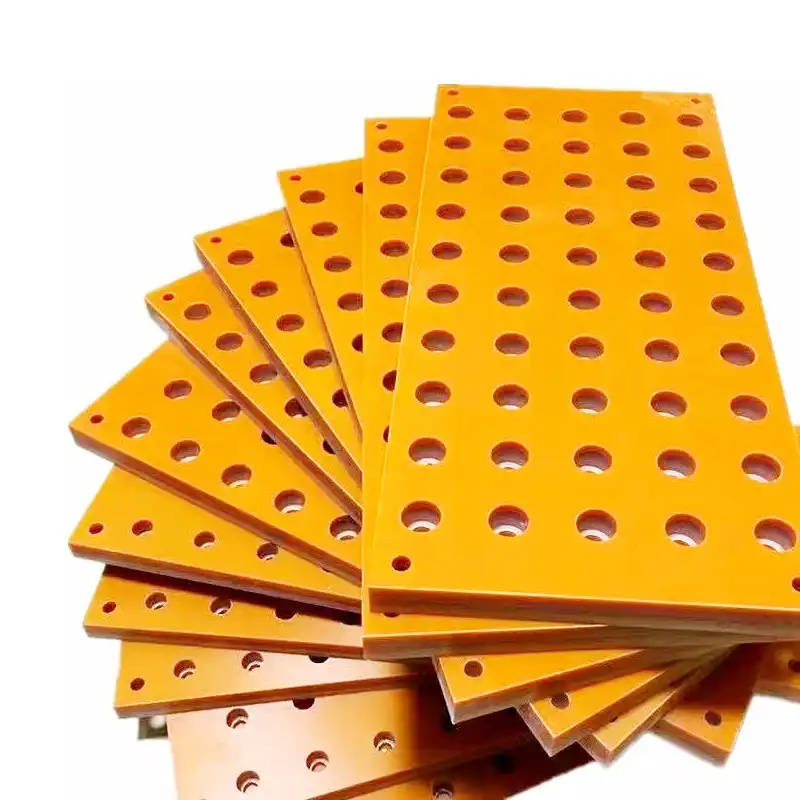
Understanding Phenolic Paper Laminate in Electrical Applications
Phenolic paper-based laminates are an important part of the electrical insulation business, especially in situations where regular plastic insulators don't work well. Cellulose paper made from wood pulp is the first step in the manufacturing process. It is impregnated with resin and then heated and pressed at temperatures above 150°C to make a rigid composite. By controlling the hardening process, the material changes into a structure with a specific gravity of 1.30 to 1.45 g/cm³. This creates the best balance between weight and strength.
Core Material Properties and NEMA Grades
Different grades of phenolic paper-based insulation have very different performance characteristics. Each grade is designed to meet specific operational needs. The different NEMA grade labels for these materials are X, XX, XXX, and their punchable versions (XP, XXP, and XXXP). These are based on the amount of resin they contain and how they are made. Grade X is better for structural uses because it has higher mechanical strength, while Grade XXX has higher resin concentration, which makes it better for electrical insulation and lowers moisture absorption below 1.0%. This grading system lets people who buy things make exact matches between material specs and application needs without over-engineering or spending too much.
Prime-grade phenolic paper sheets usually have a dielectric strength of 300–500 V/mil opposite to the laminations. This means that they can keep their shielding resistance even when it's wet outside. Temperature ratings for continuous use are usually in Class E (120°C) or Class B (130°C), which means that these materials can be used to insulate transformer coils, block arcs, and make motor parts. Stability in transformer oil settings is important for power distribution equipment, and chemical resistance to mineral oils, chlorinated hydrocarbons, and weak acids makes this possible.
Manufacturing Fundamentals and Customization
Phenolic paper insulation sheets can be made in modern factories and come in thicknesses from 0.5 mm to 50 mm. The sizes can also be changed to fit different component geometries. The material keeps its flatness very well during processing, which is very important when electrical performance depends on tight thickness tolerances. Unlike phenolic laminates made from cotton, those made from paper don't absorb as much water, so they are less likely to change size when the humidity level changes.
When purchasing materials from companies that make switchgear or motor parts, it's helpful for procurement teams to know that they need to think about both electrical and mechanical needs. The composite structure gives high-grade sheets bending strengths of over 100 MPa, which means they can hold structural loads while still insulating. Because it can do two things, it gets rid of the need for separate structural and insulating parts in many designs. This makes assembly easier and cuts down on the number of parts needed overall.
CNC Machining Phenolic Paper Laminate: Process & Benefits
To get clean edges and accurate measurements while maximizing tool life, precision machining of thermosetting laminates needs specialized knowledge. CNC technology has changed the way phenolic paper is processed from an art that needed to be done by hand to a highly repeatable production process that can make complicated shapes with tolerances of just a few hundredths of a millimeter.
The CNC Workflow for Phenolic Materials
Modern CNC machining centers use a planned process to cut Phenolic Paper Laminate sheets. The process starts with setting up the material and programming the tool path. Usually, roughing processes are used to get rid of large pieces of material, and then finishing passes are used to make the finished dimensions and surface features. When used with the right geometries, carbide tools last a lot longer than high-speed steel ones, which lowers the cost per part in large production runs.
When Phenolic Paper Laminates are machined, they have a clear advantage: they wear down tools much less than glass-reinforced composites like FR4. The lower manufacturing costs are directly related to this feature, especially when making a lot of parts, where replacing tools costs a lot of money. The paper-based structure also makes less abrasive dust when it's being cut, which keeps the shop cleaner and lowers the need for machine repair.
Precision Features and Quality Outcomes
When you use CNC machining, the edges are free of stress, which improves both mechanical performance and electrical reliability. When cutting by hand or using the wrong machine settings, tiny cracks can appear that weaken the dielectric or let water in. Computer-controlled processes get rid of these quality issues and make it possible to make complicated features like precise holes, slots, and curved edges that are impossible to make by hand.
Batch-to-batch consistency is what procurement managers and quality engineers want, and being able to program and repeat cutting operations makes that possible. When makers of car parts ask for battery pack barriers or insulation pads with exact measurements, CNC machining gives them the repeatability they need to keep production rates stable. This consistency even stretches to the creation of custom parts, where sample versions go straight from testing to full production without having to redo the whole process.
CNC-machined phenolic parts often last longer than options made by hand in a variety of settings, such as car electrical systems, aerospace insulation components, and industrial motor assemblies. According to feedback from clients working on power distribution projects, precisely machined arc barriers keep their insulating properties over long service intervals. This means that maintenance cycles and equipment downtime are cut down.
Comparing Phenolic Paper Laminate with Other Laminates for Electrical Use
When choosing a material, it's important to know about the trade-offs in performance, the costs, and the material's long-term reliability. Phenolic paper-based insulation fits into a certain area where its properties make it the best value. Other materials, on the other hand, are better suited to uses with different priorities.
Phenolic Paper Versus Fiberglass Epoxy (FR4)
For high-frequency uses and situations that need the most mechanical impact resistance, glass-reinforced epoxy laminates like FR4 are the most common choice. The fiberglass support gives the material better tensile strength and keeps its shape even when it's under a lot of mechanical stress. But for this performance, the cost of the materials is much higher, and the tools wear out much faster during machining.
Phenolic Paper Laminates perform better than FR4 specs in standard frequency electrical insulation (50/60Hz uses). Manufacturers of transformers and people who put together switchgear often find that phenolic materials made from paper provide good dielectric strength and thermal performance at prices 40 to 60 percent lower than similar FR4 parts. The easier machinability cuts down on production time and tooling costs, which makes the cost benefit even bigger when making a lot of things.
Performance Considerations Across Material Classes
Standard types of phenolic paper have UL 94 HB flammability ratings, which mean they can be controlled to burn horizontally instead of going out on their own. Chemically changed fire-retardant grades (FR-1/FR-2 ratings) that contain flame-inhibiting additives must be specified for uses that need strict fire resistance requirements. This is an important part of the procurement specification that affects both the cost of the materials and the company's ability to follow the rules.
When it comes to chemical stability and heat resistance in oily environments, Phenolic Paper Laminate is much better than unfilled plastic insulators. Because it is thermosetting, phenolic resin doesn't break at high temperatures. It keeps its mechanical qualities that thermoplastic materials can't match. This thermal stability is very important for transformers that work in environments where temperatures regularly rise above 100°C.
When choosing a material, it's important to think carefully about how different grades of phenolic absorb water. Lower grades of phenolic paper may absorb 2.5% or more by weight, while XXX-grade phenolic paper absorbs less than 1% by weight. When used in damp places or outside, you need to specify low-absorption grades to keep the electrical properties from breaking down over time and the dimensions from changing.
Procurement Considerations for Phenolic Paper Laminate
Comparing prices isn't the only thing that goes into sourcing choices; skills, quality assurance systems, and logistical factors that affect project timelines and total acquisition costs are also taken into account.
Supplier Evaluation and Quality Verification
Finding suppliers who keep their material certifications up to date and show they follow well-known industry standards is the first step to successful procurement. Compliance with NEMA LI-1, IEC 60893, and ASTM D709 makes sure that materials can be used anywhere in the world and that their performance can be predicted. Suppliers should give certifications for the materials that show they meet these requirements. These certifications should include test results for important factors like dielectric strength, water absorption, and flexural strength.
Making things to order is another important skill that suppliers need to have. Often, engineering teams need thicknesses that aren't standard or blanks that have already been machined, which speeds up the next steps in the process. Suppliers with current slitting tools and CNC skills can send you parts that are closer to their final shape, which will make your manufacturing tasks easier and increase the speed of production.
Material certifications are very important when parts are used in businesses that are controlled. Documentation of UL recognition and RoHS compliance is necessary for quality audits and regulatory submissions. Suppliers with well-established quality management systems lower the chance of material specifications not matching up, which could affect the performance of a part or its compliance with regulations.
Pricing Structures and Volume Considerations
The cost of Phenolic Paper Laminate depends on a number of things, such as the grade standard, sheet thickness, order amount, and the level of customization needed. When you buy in bulk, you can usually get discounts of 15 to 30 percent compared to small-lot pricing. This is why inventory management strategies are important for lowering costs. The price difference between standard grades (XX) and expensive low-absorption grades (XXX) is usually between 20% and 40%. This means that value engineering can be used when standard grades are appropriate for the job.
Lead times are very different depending on whether an order calls for standard stock sizes or custom manufacturing. Orders for stock materials usually ship within days, but orders for special thicknesses may take several weeks longer to complete. Logistics on a global scale take more time, especially when ocean freight is the cheapest way to ship goods. When you add enough "buffer time" to project schedules, material delays don't affect production commitments.
Navigating International Procurement
When you work with suppliers from other countries, you have to think about how to communicate, how to check the quality of the goods, and how to ship them. Established sellers with export teams can speed up the buying process by offering technical help in English and being familiar with international shipping documents. Total landing cost is calculated by adding up the terms of payment, the exchange rate, and the time it takes to clear customs.
Logistics partnerships that can do things like freight forwarding and customs brokerage make it easier for procurement teams to do their work. Integrated shipping solutions from suppliers get rid of the need for multiple service providers to coordinate, which makes the supply chain simpler and makes it easier to track shipments. Optimizing how containers are loaded and properly packing materials keeps them from getting damaged during transport, which could change their properties or cause projects to be late.
Ensuring Quality and Performance: Best Practices and Standards
Not only does the material's inherent properties affect how well Phenolic Paper Laminate works in service, but so do the right ways to handle, store, and use it throughout its entire lifecycle.
Standards Compliance and Certification Requirements
ISO-certified factories have organized quality control that lowers the variation in materials and makes sure that production outputs are always the same. These quality systems include checking the raw materials, keeping an eye on the work in progress, and final testing procedures that find problems before the goods are sent out. UL recognition is important for electrical parts that are sold in North America, where listing requirements often include insulation materials.
RoHS compliance protects people and the environment by limiting the use of dangerous materials in electronics and electrical appliances. RoHS-compliant materials are usually required by procurement standards for parts going to European markets or consumer goods sold around the world. Instead of just saying "conformity," suppliers should give test reports that show they follow the rules about substances.
Testing Protocols and Performance Verification
Post-machining verification testing makes sure that the processes used in fabrication have not changed the electrical properties. In dielectric strength tests, a high voltage is applied across the thickness of the material to make sure that the insulation resistance meets the criteria. As part of thermal resistance tests, samples are heated up and their properties or dimensions are checked to see if they change in a way that could affect their service life.
The way parts are handled has a big effect on their quality, especially when it comes to moisture exposure. If not stored properly, Phenolic Paper Laminates can absorb moisture from damp places. Moisture-related changes in size can be avoided by keeping storage temperatures around 20°C and relative humidity below 50%. Materials should be kept in covered containers until they are needed for production, and sheets should be stored horizontally on flat surfaces that are fully supported to keep them from bending.
Optimizing Component Longevity
Using the right installation techniques can make parts last longer and keep them from breaking down too soon. Specifications for fastener torque keep insulation material from being over-compressed, which could cause cracks, and the right lengths between surfaces keep electricity from moving across them. Regular inspections let you find patterns of wear or decline before a part fails and affects how the equipment works.
When materials are used in oil-immersed applications like transformers, they need to be checked to make sure they are compatible with certain insulating oils. While Phenolic Paper Laminates typically exhibit excellent oil resistance, some synthetic fluids may need to be tested for compatibility to ensure long-term stability. The expert support teams of manufacturers can help you choose the right materials for specific fluid conditions.
Conclusion
Phenolic Paper Laminate has been shown to work well in electrical insulation applications where low cost, ease of fabrication, and reliable dielectric properties are the most important factors. Understanding the differences between NEMA grades, knowing how CNC machining can help make parts, and knowing the performance trade-offs between different materials are all important for making smart purchasing decisions that balance technical needs with budget limitations. To successfully source components, you need to work with experienced suppliers who can provide you with the right materials, quality control systems, and logistics to meet your production schedules. If you use phenolic paper insulation that is properly specified and professionally made, the electrical parts you design today will work reliably for as long as they are used.
FAQ
Can phenolic paper laminates withstand cold punching operations?
To keep the edges from cracking around the holes, standard phenolic grades usually need to be heated to between 40°C and 80°C before they can be punched. Specialized grades that can be punched (XP, XXP, or XXXP) have plasticizers in them that let you punch them cold or warm and get clean edges, which is important for making a lot of parts. Specifying punchable grades cuts down on process steps and boosts production output when automatic filling and punching equipment is used in the production process. Suppliers of materials can send samples to be punched to make sure they work with certain tools and production equipment.
What storage precautions prevent material warping?
To keep phenolic paper sheets from bowing due to gravity, they need to be stored horizontally on flat pallets with support across the whole sheet area. The material isn't very hygroscopic, so keeping it in a climate-controlled space with temperatures around 20°C and relative humidity below 50% stops differences in moisture absorption that could cause it to lose its shape. Permanent damage that can't be fixed by cutting happens when things are stored vertically or aren't supported properly. To keep the environment as safe as possible, sealed packaging should stay sealed until it is used for production.
How does grade selection affect electrical performance in humid environments?
Grade XXX phenolic paper has the most resin and the least amount of moisture absorption, so it can keep its electrical properties even in places with a lot of moisture. Grade XX is a general-purpose electrical insulation that can be used in controlled indoor environments. Grade X, on the other hand, puts mechanical strength ahead of resistance to moisture. Specifying XXX grades is better for outdoor switchgear or installations in warm climates, even though the materials are more expensive. This is because the better resistance to moisture stops insulation degradation that could lead to equipment failure or safety risks.
Partner with J&Q for Precision Phenolic Paper Laminate Solutions
J&Q has been making and selling insulation products for more than twenty years and has also been serving foreign markets for more than ten years. We know exactly what electrical and electronics manufacturers, companies that make industrial machinery, and companies in the power sector want from a Phenolic Paper Laminate supplier. Standard NEMA grades and specialized punchable variants are all things we can make. All of them are made under ISO-certified quality control systems that make sure the material features stay the same from one production run to the next.
Our service is unique because we offer full logistical support through our specialized freight section. This means that we can take care of everything, from placing your order to delivering it to your building. Whether your project needs standard sheet stock that can be shipped right away or custom-machined parts that are made to your exact specifications, our technical team works with your engineering staff to find the best materials and processing conditions. Get in touch with our experts at info@jhd-material.com to talk about your unique application needs, ask for samples of materials to test for compatibility, or get full quotes for your next project. You can find more material selection guides and application case studies at blog.jhd-material.com, which is our technical resource center.
References
1. National Electrical Manufacturers Association. (2019). NEMA Standards Publication LI 1-2019: Industrial Laminated Thermosetting Products. Rosslyn, VA: NEMA.
2. International Electrotechnical Commission. (2021). IEC 60893-3-1: Insulating Materials – Industrial Rigid Laminated Sheets Based on Thermosetting Resins for Electrical Purposes – Part 3-1: Specifications for Individual Materials. Geneva: IEC.
3. ASTM International. (2020). ASTM D709-20: Standard Specification for Laminated Thermosetting Materials. West Conshohocken, PA: ASTM International.
4. Gowers, K.R. & Heywood, R.J. (2018). Electrical Insulation Materials: Properties and Performance in High Voltage Systems. IEEE Electrical Insulation Magazine, 34(4), 22-31.
5. Thompson, M.L. (2020). CNC Machining of Composite Materials: Process Optimization and Tool Life Extension. Journal of Manufacturing Processes, 58, 1247-1259.
6. Anderson, P.D. & Williams, S.T. (2017). Comparative Analysis of Thermosetting Laminates for Electrical Applications: Performance, Cost, and Manufacturing Considerations. Electrical Manufacturing & Coil Winding Conference Proceedings, 167-182.

Get a complete product list and quotation

J&Q New Composite Materials Company



