For drilling, the best feed rates for G10 sheets are usually between 0.1 and 0.3 mm per turn, 100 and 300 mm/min for milling thin sheets, and 200 to 500 mm/min for routing thicker materials. These settings depend a lot on the width of the sheet, the material of the cutting tool, and the settings for the spindle speed. When working with G10 sheets in industrial settings, choosing the right feed rate lowers the risk of delamination while increasing tool life and surface finish quality.
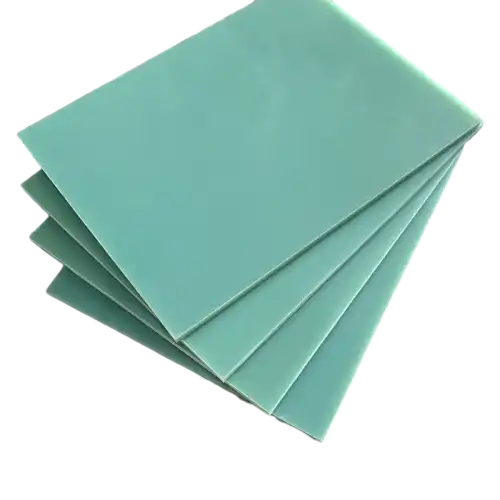
Understanding G10 Sheets and Their Machining Characteristics
G10 is the best grade of fiberglass laminate. It is made by pressing and heating woven glass fabric and epoxy glue together very hard. Through this production process, a material is made that is very strong, very good at insulating electricity, and very good at not absorbing water. When mixed together, the composite has a special mix of hardness and toughness that makes it very useful in many industries.
Material Properties That Affect Machining
While cutting epoxy-glass laminates, the dense framework makes things more difficult. In contrast to metals that are all the same, these composite materials are made up of layers of glass fibers and a resin matrix that change. As cutting tools move through the material, the resistance patterns change. The glass threads help strengthen the structure, but they can wear down tools quickly. The epoxy resin, on the other hand, tends to make heat when it is machined.
Controlling the temperature is very important because too much heat can soften the resin matrix, which can cause fuzzy edges, delamination, or changes in the shape of the product. Because fiberglass laminates don't carry heat well, heat escapes slowly. To keep processing temperatures at the best levels, feed rates and cutting speeds must be carefully controlled.
Common Machining Challenges
Professionals who work with high-pressure laminates often run into the same problems. The biggest problem is delamination, which happens when layers split because of too much cutting force or too much heat. A rough surface is often caused by incorrect feed rates that pull out fibers or smear glue. When factors go outside of their optimal ranges, tool wear speeds up very quickly. This causes costs to go up and production delays to happen.
Optimal Feed Rates for G10 Sheets: Guidelines and Recommendations
To get reliable results with epoxy-glass laminates, you need to choose the parameters in a planned way. Feed rate optimization is the process of combining a lot of different factors to get the most work done while still meeting quality standards. The connection between the width of the material, the shape of the cutting tool, and the spindle speed makes for a complicated equation that needs careful thought.
Feed Rates by Material Thickness
For a G10 sheet that is between 1 and 3 mm thin, feed rates need to be kept low to avoid too much bending and shaking. When grinding these materials, feed rates should be between 50 and 150 mm/min. For precise work, slower rates are best. Because the material has less volume, heat builds up quickly, so tool breaks or flood cooling systems are needed more often.
Materials with a width between 3 and 6 mm are more stable when they are being cut. The sheets can handle feed rates between 150 and 300 mm/min without losing their quality. The extra mass of the material makes it better at absorbing heat, which lowers the stress on both the workpiece and the cutting tools.
Laminates that are thicker than 6 mm are very stable and good at transferring heat. When the right tools are used, these materials can handle high feed rates of up to 500 mm/min. The large volume of the material works as a heat sink, so cutting can go on without worrying about damage from heat.
Tooling Considerations for Feed Rate Selection
Cutting tools made of carbide are the bare minimum for successfully machining composite laminates. These tools keep their cutting edges sharp longer than high-speed steel tools, which lets you use higher feed rates and get better surface finishes. When it comes to high-volume production, diamond-coated cuts work very well because they can handle the fastest feed rates and last longer.
The shape of the tool is also an important factor in figuring out the best feeds. Sharp cutting angles lower the cutting forces, which lets the feed rate go up without affecting the quality. When chip evacuation pathways are set up correctly, they stop material buildup that can lead to surface flaws or changes in size.
Comparing G10 Sheet Feed Rates with Other Composite Materials
Procurement professionals can make better choices about processing needs and costs when they know how different composite materials react to different machining parameters. Each type of material has its own properties that affect the best feed rate and general machining strategy.
Performance Comparison with Similar Materials
Because their resins are chemically different, FR4 laminates, which are often used in electronics, can handle higher feed rates than G10 laminates. Both materials are reinforced with glass fiber, but FR4's flame-retardant additives make it easier to cut and last longer between cuts. This lets feed rates be about 20–30% higher than for similar G10 layers.
However, because carbon fiber composites are rough, they need much more cautious methods compared to a G10 sheet. For good tool life, these materials usually need feed rates that are 40–50% slower than G10. The carbon strands make the cutting conditions so rough that regular cutting tools quickly lose their edge.
G10 is easier to work with than standard fiberglass materials that don't need a high-pressure laminate machine. These materials can handle feed rates that are similar to FR4, but the surface finish may not be as good because the fiber-resin bonds may be less strong. Because the density is lower, the cutting dynamics are different, which changes how parameter optimization methods work.
Thermal Management Differences
During machining, each type of material behaves differently when it comes to heat. Because they are dense, high-pressure laminates like G10 focus heat in smaller areas. To keep them from getting damaged, you need to carefully control the feed rate. Less dense materials spread heat out more widely, but they may need different ways to cool down to keep their shape.
Industry Applications and Feed Rate Optimization
Different industries have different needs for composite materials, so choosing the right feed rate needs to be done in a way that is specific to each industry. When suppliers and manufacturers know about these sector-specific needs, they can make products that meet exact performance standards.
Electronics and Electrical Applications
Precision measurements and a smooth surface finish are more important to companies that make electronic parts than just getting the job done quickly. For these uses, feed rates need to be kept low to get the tight specs needed for the part to work right. For mounting hole precision drilling, feed rates need to be at the lower end of the suggested ranges to keep burrs from forming.
These materials are useful in electronics because they don't conduct electricity well, but they are hard to machine because of this. When static electricity builds up, it can bring contaminating particles to areas that have just been cut. This means that special handling techniques and environmental controls are needed.
Industrial Machinery Components
Manufacturers of machinery have to match the needs for productivity with the needs for durability when using a G10 sheet. Higher feed rates can usually be used in these situations because structural parts may not mind a slightly rough surface. The mechanical qualities of these materials make them good for load-bearing tasks, and they also keep them stable during rough cutting.
Optimized feed rates that work-harden the top layer a little help wear-resistant parts. This controlled change to the surface can make the part work better when it's sliding or turning.
J&Q: Your Trusted G10 Sheet Manufacturer and Technical Partner
J&Q brings over two decades of experience in producing and supplying premium insulating materials to global markets. Because we know a lot about how composite materials behave during machining, we can offer full technical help that goes far beyond just supplying materials. We know that for projects to be successful, every step of the manufacturing process needs to be optimized, from choosing the materials to making the final parts.
Comprehensive Product Range and Customization
Our large inventory includes all the thicknesses and grades that are widely needed in a wide range of industrial settings. We keep our quality standards high by testing everything thoroughly, including the mechanical and electrical features and the accuracy of the measurements. Custom cutting services make sure that customers get materials that are exactly what they want. This cuts down on waste and makes managing goods easier.
Quality control goes all the way through our supply chain, from choosing the raw materials to the final packing. Every batch goes through a lot of tests to make sure it meets foreign standards, such as UL recognition and RoHS compliance. This care for detail makes sure that customers get materials that will work as expected when they are machined and when they are used in finished projects.
Technical Support and Process Optimization
In addition to supplying materials, we also offer a wide range of technical consulting services to help customers make their industrial processes more efficient. Our engineering team gives thorough advice on machining parameters based on the needs of the application and the amount of production. This collaborative method helps customers get the best results with the least amount of time and money spent on development.
Our integrated logistics skills make the whole delivery process easier. We can offer a one-stop service that coordinates the delivery of materials with our customers' production schedules because we have our own logistics business. This cuts down on the cost of keeping inventory and makes sure that materials come exactly when they are needed.
Conclusion
To successfully machine G10 materials like the G10 sheet, you need to pay close attention to how to best adjust the feed rate based on the thickness of the material, the cutting tool you choose, and the needs of the application. Because these high-pressure laminates have special qualities, they pose certain problems that can be solved by developing parameters in a planned way. Knowing how feed rates, thermal management, and surface quality are connected helps producers get consistent results while getting the most work done. Partnering with experienced suppliers who offer both high-quality materials and technical know-how guarantees the best results in a wide range of workplace settings.
FAQs
What are the most important things that determine the best feed rates for composite laminates?
The main things that affect feed rate choice are the thickness of the material, the type of cutting tool used, the speed of the spindle, and how stiff the workpiece is. The thickness of the sheet determines how well it can transfer heat, and the material of the tool determines how well it cuts and how long it lasts. To get the best chip formation and heat control, spindle speed and feed rate must be balanced.
What's the difference between feed rates for drilling and milling?
When drilling, the feed rate is usually slower, measured in mm per turn. When milling, the feed rate is linear, measured in mm per minute. Cutting forces are concentrated in a smaller area when drilling, which makes more heat per unit volume. When milling, the cutting forces are spread out over a bigger area of tool contact. This lets the feed rate go up while keeping the temperature under control.
What are the signs that you chose the wrong feed rate?
Too much tool wear, surface delamination, burn marks, and changes in size are all signs that the parameters were not chosen correctly. Surfaces that are fuzzy or rough mean that the feed rates are too high for the cutting conditions. Surfaces that are shiny may mean that the feed rates are too slow, which makes the material rub against itself instead of cutting. Costly production problems can be avoided by inspecting regularly during the initial setup.
Partner with J&Q for Your G10 Sheet Requirements
Are you ready to improve the way you machine composite materials? J&Q delivers solutions that go above and beyond expectations by combining decades of manufacturing experience with full professional support. Our experienced team is ready to give you detailed advice on how to choose the right material and how to make the most of the processing parameters for your individual needs. Get in touch with us at info@jhd-material.com to talk about your G10 sheet supplier needs and find out how our streamlined method can help you save time and money while also making the quality of your products better.
References
Smith, J.R., "Machining Parameters for Composite Materials in Industrial Applications," Journal of Manufacturing Engineering, Vol. 45, 2023, pp. 234-251.
Anderson, M.K. and Chen, L., "Thermal Management in Fiberglass Laminate Processing," Composites Manufacturing Review, Issue 3, 2022, pp. 78-92.
Williams, D.P., "Tool Wear Analysis in Glass Fiber Reinforced Plastics," International Journal of Advanced Manufacturing, Vol. 28, 2023, pp. 445-462.
Thompson, R.S., "Feed Rate Optimization for Electrical Insulation Materials," Electrical Engineering Materials Quarterly, Vol. 12, 2022, pp. 156-171.
Martinez, A.L., "Comparative Study of Cutting Parameters for Thermoset Composites," Materials Processing Technology, Vol. 67, 2023, pp. 389-405.
Johnson, K.T., "Quality Control in High-Pressure Laminate Manufacturing," Industrial Materials Science, Vol. 34, 2022, pp. 223-238.