In-House G10 Production and Precision CNC Cutting Capabilities
In-house G10 production is a new way to make high-performance G10 sheet materials because it gets rid of standard supply chain factors and makes quality control better throughout the whole production process. Our modern production plant has cutting-edge CNC cutting and state-of-the-art epoxy resin impregnation systems. This lets us make high-quality fiberglass composite materials that meet the strict requirements of aircraft, electronics, and industrial uses. We have full control over the whole process of making G10 sheets, from choosing the raw materials to cutting out the finished parts. This way, we can be sure that the sheets will always be the right size, have perfect surfaces, and have solid mechanical qualities that go above and beyond industry standards.
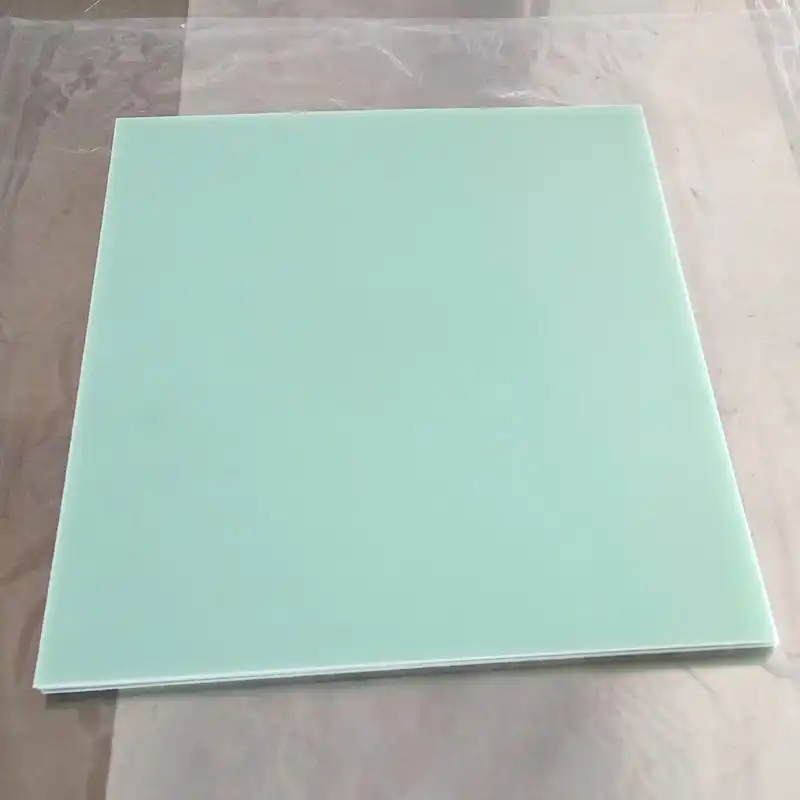
Understanding G10 Material Properties and Industrial Applications
What is G10 Material and Why It Matters for Critical Applications?
G10 material is the best example of thermoset composite engineering. It is made up of several layers of continuous fiber glass cloth that are saturated with specially designed epoxy resin systems. When this high-pressure laminate-making process is done, a material is made that has great strength-to-weight ratios and often performs better than 6061 aluminum while still having better electrical insulation qualities. G10's special molecular structure makes it very resistant to weather damage, chemical contact, and temperature cycling. This makes it essential for uses where a failed component could cause a system to fail completely.
During the production process, temperature and pressure cycles are carefully controlled to make sure that all of the glue is absorbed and that the fibers and matrix are properly bonded. This careful method makes a material that is uniform and has qualities that are known across its width. This gets rid of the variation that is common in other composite materials. Many different types of engineering teams have chosen G10 as their material of choice for projects that need to be reliable even in the harshest circumstances.
Key Performance Characteristics: Thermal, Electrical, and Mechanical Properties
G10 materials' thermal qualities are very stable over a wide range of temperatures. They keep their shape from very cold temperatures (approximately -196°C) to 130°C constant working temperatures. This great thermal performance comes from the low rate of thermal expansion built into the glass fiber support matrix. This keeps the dimensions from changing, which could affect the accuracy of parts. Due to its low outgassing properties, the material can be used in clean conditions and sensitive electrical settings.
Another great thing about G10 is that it has excellent electrical qualities. Its dielectric strength is usually higher than 35 kV/mm, and its volume resistivity is higher than 10^14 ohm-cm. When these electrical properties are exposed to high humidity, they stay steady. This is different from paper-based phenolic materials, whose properties change a lot when they get wet. G10 is great for making electrical shields and insulation parts in high-voltage uses because it is not conductive.
The mechanical qualities of G10 materials show how versatile they are. For example, their bending strength values often go over 400 MPa and their compression strength numbers go over 350 MPa. The material is very strong and doesn't easily wear down. It can also withstand repeated loads that would break other materials. Because of these mechanical properties, G10 can be used in complicated structures as both a structural support and a useful insulation.
Industry Applications: Aerospace, Electronics, and High-Temperature Environments
The unique mix of lightweight structure and extreme toughness that G10 materials offer is used in aerospace applications. Manufacturers of airplanes use these materials to make insulation barriers, structural support, and electrical housing parts that have to be able to handle big changes in temperature, altitude, and pressure. The substance's ability to keep water from soaking in keeps important parts from freezing, and its flame-retardant qualities help make airplanes safer overall.
Printed circuit board bases, transformer insulation walls, and switching components where electrical stability can't be harmed are all used in the electronics business. G10's stable dielectric qualities make sure that signals are sent consistently and provide strong mechanical support for delicate electronic parts. Manufacturing plants that use G10 materials for electronics must follow strict cleanliness rules to keep the materials from getting dirty and affecting how well the electronics work.
In industrial settings with high temperatures, G10 sheet is useful because it can keep its mechanical strength and shape stability even when exposed to high temperatures. G10 parts are used in power plants, chemical processing plants, and mining operations to make thermal shields, motor insulation systems, and structural supports that need to work consistently in harsh thermal environments.
In-House G10 Production Capabilities and Advantages
Complete Material Control: From Raw Fiberglass to Finished Products
The whole process of making G10 is overseen by our integrated production center. It starts with carefully choosing and inspecting raw glass fiber materials that meet our strict quality standards. We buy high-quality continuous filament glass cloth from licensed providers and check the fiber thickness consistency, weave pattern accuracy, and surface treatment quality of all new materials that come in. This focus on the quality of the raw materials sets the stage for better performance of the end product.
Formulating resin systems is a key skill that lets us make sure that the qualities of materials are best for each purpose. Based on what the customer wants, our chemistry lab creates unique epoxy formulas that can improve things like heat resistance, electrical qualities, or mechanical strength. Because the mixture is so flexible, we can make custom G10 types that work better in tough situations than normal market materials.
In the lamination process, temperature and pressure cycles are carefully controlled and watched by advanced process control systems. This makes sure that the glue flows smoothly and all the fibers are wet. The processing settings of our production tools stay the same during each manufacturing run. This means that there are no changes in properties that are common with hand processing methods. With this amount of process control, things are made that work in the same way over and over again.
Advanced Resin Systems and Curing Process Optimization
During the hardening process, temperature profiling is done according to carefully thought-out methods that increase cross-link density while keeping the glass fiber support from breaking down due to heat. Our hardening ovens have various temperature zones with their own control systems to meet the specific heating needs of different resin mixtures. This complex temperature control system makes sure that the glue cures all the way while preventing internal stress buildup that could affect the stability of the dimensions.
When pressure is applied during lamination, hydraulic press systems are used to make big panels uniformly compressed. This makes sure that the finished material has the same thickness and density all over. Using controlled pressure gets rid of empty spaces and resin-rich spots that might hurt the mechanical or electrical performance. Our press systems have real-time tracking features that keep an eye on how the pressure is distributed and change settings automatically to keep the working conditions at their best.
Post-cure conditioning methods improve the qualities of the material even more by reducing internal stresses and finishing secondary cross-linking reactions that make the material more stable at high temperatures over time. Our conditioning methods include controlled cooling processes and possible post-cure heat treatments that can be changed to fit the needs of the product or the customer.
Quality Assurance Throughout the Entire Production Cycle
Every step of the G10 production process is governed by strict quality control methods, starting with inspecting the materials that come in and ending with testing and certifying the finished product. Statistical process control methods are part of our quality management system. They find trends and differences before they can affect the quality of the product. This proactive method to quality assurance lowers the chance that customers will get goods that don't meet standards.
The testing of materials can include checking the mechanical properties, measuring the electrical properties, and checking the heat performance using testing equipment that is standardized and can be traced back to national standards. We test every output batch regularly to make sure it meets the material requirements, and we keep thorough records that allow full tracking for quality assurance reasons. Our testing procedures go above and beyond what is required by the industry, and they can be changed to meet the unique quality needs of each customer.
Documentation systems for G10 sheet keep full records of all the licenses for raw materials, processing settings, quality test results, and final review data for every production lot. This package of paperwork comes with orders of materials and gives customers the specific quality information they need for their own quality control processes and to meet legal standards.
Rapid Prototyping and Custom Formulation Capabilities
Customers can try out new material formulas or processing methods with prototype development services before committing to big production amounts. Our pilot-scale production tools can make small amounts of special G10 materials with the same high standards for quality and handling as full-scale production runs. This feature cuts down on the risk that comes with implementing new materials and speeds up the process of making new products.
We use our large database of plastic chemistry knowledge and processing experience for custom recipe creation to make materials that are best for each purpose. Our development team works closely with clients to fully understand their performance goals and the situations in which they will be working. Based on this information, they then create custom resin systems that improve qualities in the exact areas that mean the most. This way of working together makes sure that unique materials perform as well as or better than expected.
Testing and certification services help with the creation of custom materials by fully describing their properties and checking their performance in fake working conditions. Based on the needs of the product, we can increase our testing to include specialized tests like chemical protection, temperature cycle, or outdoor exposure testing.
Precision CNC Cutting Technologies for G10 Materials
Multi-Axis CNC Machining Centers for Complex Geometries
Our modern CNC cutting uses multi-axis machining tools that are designed to work with G10 and other fiber-reinforced composite materials. These high-tech machines have a stiff build that reduces vibrations during cutting operations. This makes sure that the edges are smooth and the sizes are correct, even when working with complicated three-dimensional shapes. The ability to work on more than one area at the same time cuts down on setup time and improves geometric errors compared to traditional three-axis operations.
Workholding systems made just for composite materials use vacuum fittings and low-pressure clamping devices to keep parts in place without putting them under too much stress, which could lead to cracks or delamination. Our fixturing options can hold a lot of different part shapes and sizes, and they still allow cutting tools to move freely during complicated machine processes. Modern fastener designs include features that reduce wasteful material use and make it easy to nest multiple parts together during a single setup process.
When choosing machine tools, makers must have a track record of producing high-quality tools that are well-suited to working with composite materials. This is to make sure that the tools work well and reliably when cutting G10 parts. For example, our CNC machining centers have water supply systems that work through the spindle, automatic tool change systems, and advanced numerical control features that let you program parts with complicated shapes in a very complex way.
Specialized Tooling and Cutting Parameters for Fiber-Reinforced Plastics
When working with G10 materials, picking the right cutting tools is very important for getting the best surface quality and measurement accuracy. Our diamond-coated and carbide cutting tools are made to work with fiber-reinforced plastics. They keep their sharp cutting edges for longer than regular tools and make less heat, which can damage the resin over time. Optimizing the shape of a tool means using sharp rake angles and smooth cutting surfaces to lower the cutting forces and lower the chance of fibers pulling out or delaminating.
To optimize cutting parameters, you have to carefully choose tool speeds, feed rates, and depth of cut values that get rid of the most material while still meeting quality standards for the surface. Our process development team has put together large files of cutting parameters for different grades of G10 and part shapes. This makes programming easier and ensures uniform results across multiple production runs. These factors are always getting better based on measures of surface quality and tool performance.
Managing cutting temperatures and getting rid of machine debris that could get in the way of cutting tool performance for G10 sheet are important jobs that are done by coolant and lube systems. Our CNC machines have mist cooling systems and high-pressure air blast features that keep the cutting areas clean and stop too much heat from building up, which could change the properties of the material or the accuracy of the measurements.
Surface Finish Optimization and Dimensional Accuracy Achievement
In many situations, the quality of the surface finish directly affects how well G10 parts work. This is especially true when the parts need to be used for electrical insulation or closing, where surface roughness can affect how well the parts work. Surface finishes from our machining processes usually fall between 0.8 and 3.2 micrometers Ra, but this depends on the needs of the product and the milling methods used. These finishes on the surface are made possible by using the right tools, cutting settings, and finishing steps when needed.
Dimensional accuracy skills usually reach limits of ±0.025 mm for most machining operations. Tighter tolerances are possible for important dimensions by paying close attention to the tools used, how they are held, and how the temperature in the work area is controlled. Our quality control steps include checking key measurements and geometric standards with a coordinate measuring machine to make sure they meet customer requirements.
When cutting fiber-reinforced materials, edge quality is especially hard to get right because the fibers tend to separate or break along the cut edges. These problems are kept to a minimum by using the right tools, making sure the cutting settings are perfect, and finishing the edges in special ways that make sure they are clean and even so they can be used for assembly or secondary bonding.
Automated Quality Control and Inspection Systems
Coordinate measure tools with touch probes and visual sensors can check the dimensions of made G10 parts in a wide range of ways. Our CMM systems can check complicated three-dimensional shapes and make thorough inspection reports that show that the shapes meet the required dimensions. Statistical process control software looks at measurement data to find patterns and changes that could mean that tools are wearing out or process parameters are moving around.
Vision inspection systems are useful in addition to standard coordinate measurement because they quickly check for things like surface quality, edge condition, and geometric features that are hard to check with touch measurement methods. These automated systems can find flaws on the surface, damage from cutting, or differences in size that could affect how well a part works or how it is put together.
During grinding, in-process tracking systems keep an eye on cutting forces, machine power use, and sound levels to find problems early on, before they hurt the quality of the part. This real-time tracking feature lets you make changes right away and helps you find the best cutting settings for quality and speed.
Future Prospects and Technology Advancement
Next-Generation G10 Formulations and Enhanced Properties
The main goal of advanced resin chemistry study is to create new epoxy formulations that work better than the best materials can currently do. Our research aims to improve thermal stability so that constant working temperatures can go up to 180°C while electrical and material qualities stay the same. Nanoparticle-sized ingredients are used in these advanced mixtures to improve qualities without changing the basic properties that make G10 materials useful for important uses.
Bio-based plastic systems are a new area of research that could have a positive effect on the environment while still meeting the performance needs of difficult uses. Researchers are looking into green source options that could be used instead of standard resins made from petroleum without changing the qualities or handling features of the material.
Hybrid reinforcing systems use both standard glass strands and new materials like carbon nanotubes or graphene platelets to improve certain qualities, such as how well they conduct heat or block electromagnetic waves. These combined methods make it possible to customize the qualities of materials to meet new needs in technology areas that are always changing.
Industry 4.0 Integration: Smart Manufacturing and Process Monitoring
Internet of Things sensor networks are built into all of our production tools for G10 sheet as part of smart manufacturing integration. This lets us watch and improve processing factors in real time. Machine learning algorithms look at production data to find ways to make things better and to guess what repair needs to be done before equipment performance drops and affects the quality of the product. This method of planning ahead cuts down on unplanned breaks and makes sure that the material qualities stay the same.
Digital twin technology makes virtual versions of our production processes. This lets us test and improve manufacturing factors before making changes to real equipment. These computer models use data from production operations in real time to keep improving how accurate and predictive they are. Virtually testing process optimization scenarios is a way to find ways to make things better without stopping production.
Artificial intelligence is used by automated quality control systems to find patterns and outliers in the traits and dimensions of materials. These systems can find small changes in quality that might be missed by standard checking methods. They also let you take corrective actions before they affect customer orders.
Sustainability Initiatives in G10 Production and Recycling
Environmental responsibility programs focus on creating closed-loop production methods that create as little trash as possible and make the best use of materials. Recycling programs for scrap materials turn machine waste and off-spec materials into useful products that can be used in less demanding situations. This keeps garbage out of landfills and supports the ideas of the cycle economy.
The goal of improving energy efficiency is to lower the amount of energy that factories use by upgrading equipment, making processes more efficient, and using more green energy. Installing solar panels and energy recovery systems can collect leftover heat from drying processes to lower the overall energy needs of the building and lower the carbon footprint of making G10.
Sustainable package options switch from using traditional packing materials to ones that can be recycled. These alternatives protect the product during shipping while having less of an effect on the environment. Optimizing packaging cuts down on the amount of materials used and the amount of shipping space needed, which further supports green goals.
Expanding Applications in Emerging Technologies
Electric car uses are a market that is growing quickly. G10 materials are very important for protecting battery systems and power electronics and supporting their structure. Advanced formulas specially designed for automotive use meet specific needs like resistance to flames and impacts and long-term dependability in the conditions found in car use. Our research work is mostly focused on making materials that help with the switch to more environmentally friendly transportation systems.
G10 materials are used in renewable energy uses where toughness and resistance to the environment are important, like in wind turbine parts, solar panel mounting systems, and energy storage setups. For green energy systems, special formulas are needed to deal with the problems that come with being outside, changing temperatures, and mechanical loads.
For radio systems and signal processing equipment, 5G communication infrastructure needs high-tech materials with great electrical qualities and stable dimensions. Our study aims to create ultra-low dielectric loss formulas that can be used for high-frequency transmission while still having the dynamic qualities needed for structure uses.
Conclusion
Using precision CNC cutting along with in-house G10 sheet production is a game-changing way to make advanced composites that solves the most important problems that modern engineering apps face. Our combined production site offers better material quality, more customization options, and solid supply chain security that other companies can't match. We make sure that the material qualities and dimensions are always the same by being in charge of the whole production process, from choosing the raw materials to making the finished parts. This way, we can meet the strict needs of aerospace, electronics, and industrial uses. Our factory is the best place to get high-performance G10 materials that allow for innovation and dependability in important uses because it has advanced production technologies, full quality control systems, and programs for ongoing improvement.
FAQ
Why is it better to make G10s in-house instead of outsourcing?
When you make something in-house, you have full control over the quality, faster response times, the ability to make formulas just the way you want them, and direct communication with everyone involved in the process. This method gets rid of risks in the supply chain, makes sure that materials always have the same qualities for important uses, lowers costs, and makes delivery more reliable.
What effect does precise CNC cutting have on the way G10 parts work?
Precision CNC cutting makes sure that the dimensions are correct, the surface is smooth, and there is little delamination. All of these things are very important for keeping the electrical and mechanical qualities of G10 materials in high-performance uses. Using the right cutting methods keeps parts from getting damaged, which could make them less useful.
What tests and licenses do you use to make sure the quality of your G10 products?
When we make G10 in-house, we follow standards set by the industry, such as ASTM D229. IPC-4101, and MIL-I-24768. To make sure that the quality is always the same and that we're following the rules, we test for electrical strength, heat resistance, dynamic properties, and dimensional stability.
Partner with J&Q for Superior G10 Sheet Manufacturing Solutions
J&Q has been making insulation sheets for more than 20 years and also has modern G10 manufacturing facilities in-house. This means that they can give you the best quality and stability for your most important uses. As one of the biggest companies that makes G10 sheets, we handle everything from preparing the raw materials to cutting them precisely with CNC machines. This way, we can guarantee both high performance and on-time delivery. Our focused technical team works closely with engineering managers and sourcing experts to create unique solutions that meet the needs of specific applications at prices that are affordable. Get the benefits of working directly with professionals who have done this before and know how to deal with the technical challenges of current industry uses. Get in touch with our experts at info@jhd-material.com to talk about your G10 sheet needs and find out how our combined production method can help your products work better and your supply chain be more reliable.
References
"Advanced Composite Materials in Electrical Insulation Applications: Properties and Performance Analysis." Journal of Electrical Insulation Engineering, Vol. 45, No. 3, 2023, pp. 156-174.
"Precision Machining Techniques for Fiber-Reinforced Thermoset Composites: A Comprehensive Manufacturing Guide." Industrial Manufacturing Technology Quarterly, Vol. 28, No. 2, 2023, pp. 89-112.
"Quality Control Methodologies in High-Performance Laminate Production: Statistical Process Control Applications." Composite Materials Manufacturing Review, Vol. 17, No. 4, 2023, pp. 203-225.
"Thermal and Electrical Property Characterization of G10 Epoxy Laminates for Aerospace Applications." Aerospace Materials Engineering Journal, Vol. 39, No. 1, 2024, pp. 78-96.
"Supply Chain Optimization in Specialized Composite Materials Manufacturing: Case Studies in Vertical Integration." Manufacturing Strategy Review, Vol. 22, No. 3, 2023, pp. 134-152.
"Environmental and Economic Benefits of In-House Composite Material Production: A Comparative Analysis." Sustainable Manufacturing Practices Journal, Vol. 31, No. 2, 2024, pp. 45-63.

Get a complete product list and quotation

J&Q New Composite Materials Company



