High-Speed CNC Machining Solutions for FR4 Insulation Parts
When it comes to making precise electrical insulation parts, high-speed CNC machining options for FR4 insulation parts are the cutting edge. Using specialized tools, improved cutting settings, and high-tech CAD/CAM systems, these advanced manufacturing methods make FR4 insulation parts that are very accurate in size and have a smooth surface. When compared to older ways of making things, modern CNC machine centers give better results. This lets makers meet strict electrical and mechanical requirements for many industrial uses.
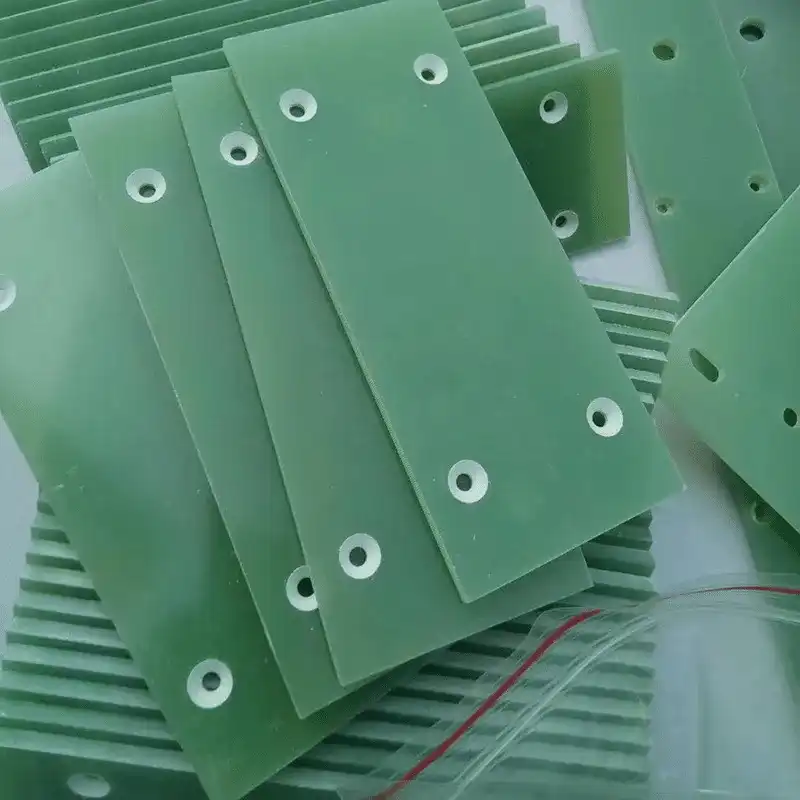
What is FR4 Insulation Material and Why CNC Machining Matters?
Understanding FR4 Material Properties
The industry standard for electrical insulation uses is FR4 insulation board, which has both great material strength and great electrical qualities. This thermosetting laminate is made up of continuous thread glass cloth that has been mixed with epoxy glue to make a hybrid material that performs amazingly well. The marking "FR4" means that the material is flame resistant and meets UL94 V-0 standards. This means that the material will put out the fire itself within 10 seconds of removing the source of burning.
The precise specs of the material are very good, which makes it perfect for tough uses. Based on its density, which is between 1.85 and 2.10 g/cm³, FR4 offers strong structure stability while still being relatively light. The material has a flexural strength of more than 340 MPa, which means it can handle a lot of mechanical stress without breaking. It also has an impact strength of about 250 J/m, which means it can handle shock loads that are common in industrial settings.
Electrical properties demonstrate the material's superior insulation capabilities. The breakdown voltage of more than 40–50 kV parallel to layers provides great high-voltage separation, and the dielectric constant of 4.4–4.8 at 1MHz makes sure that the electrical performance is stable across a wide range of frequency ranges. The amount of water absorbed stays below 0.1%, so electrical features don't change when it's wet. Because of these qualities, FR4 is very useful for PCB boards, circuit components, and motor shielding where it needs to work reliably in a wide range of weather conditions.
Traditional FR4 Machining Limitations
FR4 hybrid materials often pose problems that can't be solved with standard cutting methods. During normal drilling operations, delamination often happens at the entry and exit places. This makes surfaces rough, which is bad for both looks and functionality. The roughness of the glass fibers in the FR4 matrix speeds up tool wear, which raises production costs and causes part quality to vary as cutting edges wear down over long production runs.
When using standard grinding methods, problems with surface quality are especially bad. When cutting with a router, the edges are often fuzzy and there are tiny cracks that can grow when the part is stressed, which could lead to early failure in important applications. When standard tools don't have the stiffness and exact control needed to keep tight tolerances across different material sizes, measurements become less accurate.
FR4 materials have extra problems to deal with when they get heated up during normal cutting processes. Too high of temperatures can break down plastic in certain areas, which can change its electrical and mechanical qualities. Standard cooling systems might not be able to keep the temperature under control well enough, especially when working with thick pieces or complicated shapes that need longer cutting times.
The High-Speed CNC Advantage
With the help of cutting-edge technology and better methods, high-speed CNC turning of FR4 insulation part turns these problems into competitive benefits. When high-speed precision spindle systems are used, they allow for clean cutting that reduces delamination and makes edges that are better. When you combine high spinning speeds with carefully controlled feed rates, you get shearing action that cuts through material easily without the tearing that happens when cutting at slower speeds.
The better cutting movements that come with high-speed machining lead to a better surface finish. With less cutting force and better chip removal, surfaces are smoother and don't need as much post-processing. Manufacturers who need high-quality finished parts will save money and cut down on production times thanks to this improvement.
When high-speed CNC technology is used, production wait times go down by a lot. When you combine faster cutting speeds with automatic tool change and more advanced CAD/CAM code, you can quickly go from an idea for a design to finished parts. This feature is especially useful for engineering teams that are making prototypes or handling tight production plans.
High-Speed CNC Machining Technologies for FR4 Parts
Advanced Spindle Systems and Tool Selection
Modern CNC cutting centers have high-frequency wheels that are designed to work best with composite materials. These carefully designed systems can work at speeds higher than 40,000 RPM while still being very accurate and having very little runout. High-speed operation improves the cutting dynamics, which lets clean material removal happen without the force-related delamination that happens with traditional methods of machining.
Specialized cutting tools made for FR4 use advanced carbide surfaces and optimized shapes to make the tools last longer and cut better. When working with the rough glass fiber content, diamond-coated end mills offer great wear resistance. Specialized flute designs help chips escape quickly and keep the work area from getting too hot while cutting. Because of these advances in technology, part quality stays the same and making costs go down over longer production runs.
Tool covering technologies are a big part of why high-speed FR4 cutting works so well. Advanced PVD coats make cutting tools less likely to scratch and heat up while also making them more resistant to wear than cutting tools that aren't covered. These coats make tools last longer and keep their sharp cutting edges for longer production runs. This keeps part quality and accuracy in measurements steady.
Cutting Parameter Optimization
To get the best results when making FR4 materials, you need to carefully consider cutting factors that are made to fit the sizes of the materials and the shapes of the parts. Feed rates, which rely on the width of the tool and the thickness of the material, should be between 1000 and 3000 mm/min to get the best mix between output and surface quality. Spindle speeds are usually kept between 15,000 and 30,000 RPM to make sure clean cuts and keep heat from building up too much.
Coolant systems are very important for keeping the cutting conditions and quality of the parts at their best. Precision mist or flood cooling systems help keep the temperature in check and clean up dirt that could scratch finished surfaces. The right choice of coolant makes sure that it works with FR4 materials and gives tools the lubrication and cooling they need to last longer.
During the grinding process, quality control includes keeping an eye on the cutting forces, surface temperatures, and uniformity of the dimensions. Modern CNC systems give input in real time, which lets the cutting settings be changed automatically to keep the conditions at their best throughout the production cycle. This feature makes sure that the quality of the parts stays the same even during long production runs or when working with materials that have different properties.
CAD/CAM Integration for Complex Geometries
Modern CAD/CAM systems have advanced 3D modeling tools that make it easy to go from an idea for a design to finished FR4 insulation parts. These systems can handle complicated shapes like detailed cutouts, curvy surfaces, and precision holes, and they instantly create the best toolpaths for cutting materials efficiently. Advanced modeling tools make sure that the right gaps and measurements are used throughout the whole production process.
Automated toolpath creation for FR4 insulation part figures out the best ways to make by looking at the features of the material, the cutting tool, and the machine itself. These complex formulas cut down on the time needed for cutting while still ensuring high-quality parts that are the right size and shape. CAM code that includes cutting factors specific to the material gets rid of the need to guess and speeds up the setup time for new projects.
Simulation and testing methods let you fully understand how machining works before the real cutting starts. These features find possible problems like tool crashes, too much cutting force, or a poor surface finish, so that machine methods can be improved before they are put into production. This proactive method cuts down on waste, keeps machine costs low, and makes sure that even the most difficult FR4 machining projects are finished successfully.
Applications and Industries Benefiting from CNC Machined FR4 Parts
Electronics and PCB Manufacturing
Precision-machined FR4 insulation parts are most often used in the electronics business, which needs them for a wide range of important tasks. Insulation spacers and standoffs are necessary for keeping electrical interference at bay in high-density circuit designs where precise spacing between sensitive elements is important. Tough size limits must be met by these parts, and they must also provide effective electrical protection in a range of temperature and humidity conditions.
In tough industrial settings, custom electrical boxes made from FR4 materials protect sensitive electronic parts better than other options. These shelters can handle both electrical stress and physical effects that are common in industrial settings because they are both very strong and good at blocking electricity. High-speed CNC cutting makes it possible to make complicated container shapes with precise fixing holes and built-in cooling channels.
These days, CNC machine technology is very good at making very precise parts for high-voltage separation. To keep the electrical connections from breaking down in harsh working conditions, these important safety parts need to be very accurate in terms of their size and quality. Reliable performance in power distribution systems and industrial electrical equipment depends on being able to keep quality high across big production runs.
Aerospace and Defense Applications
When it comes to safety and efficiency, aerospace uses need the best electrical insulation parts. In aircraft settings, radar system insulators have to keep their exact electrical qualities while also being able to handle large changes in temperature and mechanical movements. High-speed CNC cutting makes it possible to make complicated shapes with cooling channels built in and precise fixing features that are needed for aircraft uses.
To keep important guidance and communication systems safe, avionics housing components need to be very stable in terms of size and electrical protection. Because FR4 materials are very light and have great electrical qualities, they are perfect for uses in aircraft where weight reduction is still important. CNC cutting makes it possible to make complicated housing shapes that have built-in EMI protection and precise connection mounting features.
Advanced CNC cutting technology makes it possible to be very precise, which is useful for protecting against electromagnetic radiation. For proper system integration, these parts must effectively separate electrical currents while keeping exact size limits. The best EMI security in sensitive defense and aircraft systems comes from being able to make complicated shapes with tight tolerances.
Industrial Equipment Solutions
Motor mounting insulators are very important safety parts in industrial electrical systems, so they need to be very strong mechanically and electrically. These parts have to be able to handle a lot of mechanical stress while also keeping motor parts and mounting frames electrically separate. High-speed CNC cutting makes it possible to make complicated mounting shapes with precise bolt patterns and built-in features that reduce shaking.
These days, CNC cutting technology is very good at making very precise FR4 insulation part for transformers. To make sure they fit correctly and work well with electricity, insulation walls, coil supports, and fixing clamps need to be very accurate in their measurements. Transformer performance and dependability are always the same because of the ability to keep tolerances tight across big production numbers.
Accessories for power distribution, like busbar supports, phase barriers, and arc chutes, need to be carefully made to make sure they work well even when there is a lot of electrical stress. These parts have to be able to handle both electrical and mechanical forces while staying the same size over a long period of time. Advanced CNC cutting technology makes it possible to make parts with complicated shapes that are best for their electrical and mechanical needs.
Quality Standards and Specifications for CNC Machined FR4
International Standards Compliance
Modern FR4 insulation parts have to meet a lot of international standards to make sure they are safe, work well, and are safe for the earth. IPC guidelines for electronic applications spell out in detail what qualities materials must have, how they must be sized, and how they must be tested for use in printed circuit board applications. These guidelines make sure that quality and efficiency are the same across all makers and areas.
UL flame retardancy ratings show that FR4 materials meet strict fire safety standards that are needed for electrical uses. The UL94 V-0 grade means that materials will put out their own fires within 10 seconds of being removed from a fuel source. This stops fires from spreading in electrical systems. This approval is especially important for parts that are used in public buildings, transportation systems, and factories, where fire safety is very important.
RoHS environmental compliance makes sure that FR4 materials don't have any banned dangerous chemicals that could harm people or the environment. Electronic parts sold in many global markets must now have this approval, so makers who want to do business with other countries must follow the rules. CNC-machined FR4 parts stay RoHS compliant throughout the whole production process thanks to advanced manufacturing techniques.
Precision Tolerances and Surface Finish
With normal limits running from ±0.05mm to ±0.1mm based on part shape and size, high-speed CNC cutting makes it possible to get very accurate measurements. Tolerances as tight as ±0.025mm can be reached in more difficult situations by paying close attention to the cutting settings, the tools used, and the weather controls. These high-precision features make sure that things fit and work right in important situations where accuracy in measurements has a direct effect on performance.
Surface roughness standards for CNC-machined FR4 parts are usually between 1.6 and 6.3 Ra, but this depends on the needs of the product and the cutting settings. Critical areas that need a high-quality finish can get roughness values below 0.8 Ra by using the best cutting settings and performing special finishing steps. There are changes to the surface quality that make finished parts look better and work better.
Edge quality and finishing without burrs are important quality factors for FR4 insulation parts. High-speed CNC cutting makes lines that are clean and sharp, with almost no delamination or fiber pull-out, which happens with other types of machining. Cutting techniques that are more advanced and specialized tools make sure that the quality of the edges stays the same throughout production runs. This means that expensive extra finishing operations are not needed.
Testing and Validation Procedures
Electrical property testing makes sure that cut FR4 parts keep their required insulation properties during the whole production process. Standard testing methods include checking the dielectric constant, trying the dielectric strength, and measuring the insulator resistance. These tests show that the electrical qualities needed for the part to work properly have not been changed by the grinding process.
Testing the mechanical strength of CNC-machined parts makes sure that they can handle certain loads in a variety of stress situations. Flexural strength, impact resistance, and fatigue testing under repeated loading conditions are some of the tests that are done. These thorough tests make sure that parts will work reliably for as long as they are supposed to.
Thermal performance test for FR4 insulation part shows that FR4 parts keep their features at high temperatures that are typical in electrical uses. Some of the tests that are used are thermal cycling, constant high-temperature contact, and a test of thermal shock protection. These tests make sure that the parts will work reliably in situations where the temperatures change a lot during everyday use.
Selecting the Right CNC Machining Partner for FR4 Projects
Technical Capabilities Assessment
When looking for possible CNC cutting partners, it's important to carefully look at their equipment specs and producing skills. High-speed machining centers with precise wheels should be standard in modern facilities so that they can keep tight tolerances while handling FR4 materials quickly. Advanced control systems make it possible to get stable results even when the amount of production changes. They also keep the freedom needed for unique uses.
Quality management systems show that a company is dedicated to getting regular results and always getting better. With ISO approval, you can be sure that set quality standards are being followed throughout the whole producing process. Coordinate measure tools and statistical process control systems are examples of high-tech quality control equipment that make sure that parts are made correctly and consistently across production runs.
Engineering help and design assistance make it possible for producers and their customers to work together well. During the planning process, experienced engineering teams can give useful feedback by finding ways to cut costs and make the product easier to make. This way of working together usually leads to better goods that are provided at low prices and in less time.
Production Scalability and Lead Times
For the prototype to production shift to go smoothly, you need manufacturing partners who can go from making a few items to making a lot of them while keeping the quality good and the prices low. Modern CNC factories use adaptable production systems that can handle changing production numbers without affecting quality or delivery times. This flexibility makes sure that things stay the same from the beginning of development to full-scale production.
When projects move from planning to full production, the ability to make a lot of things at once becomes very important. Manufacturing partners must show that they can handle high production numbers while still meeting the quality standards set during the development of prototypes. Advanced methods for planning and organizing make sure that deliveries always happen, even when demand is high.
Location, backup manufacturing options, and inventory management systems that make sure materials are always available are all factors that affect the dependability of the supply chain. When manufacturers have a variety of supply sources and handle their goods strategically, they are better able to adapt to changes in demand and problems in the supply chain that could affect delivery dates.
Cost Optimization Strategies
In FR4 cutting uses, improving the efficiency of material consumption is a big chance to cut costs. With advanced stacking software, the shape of parts is optimized to keep production flowing smoothly and waste as little as possible. By carefully planning and using the best cutting methods, experienced makers can get material utilization rates of over 85%. This means that less material is wasted and less damage is done to the environment.
The benefits of batch processing make it possible to make a variety of parts at low cost by optimizing timing and setup processes. When manufacturers use advanced planning systems, they can group together parts that are similar to make more efficient production batches. This lowers the cost of setup and raises total productivity. Because of these advantages, prices are kept low for customers while quality standards are kept high.
Some of the long-term benefits of a relationship are bulk discounts, priority scheduling, and tech help that goes beyond just production services. Partnerships that are already in place help producers and their customers communicate better, respond faster, and solve problems before they happen. Because of these connections, there are often ongoing efforts to make things better and cheaper over time.
Conclusion
The production of FR4 insulation parts has been completely changed by high-speed CNC cutting technology, which has made it possible for producers to reach new levels of accuracy, quality, and economy. When you combine advanced spinning systems, specialized tools, and improved cutting settings, you get better results than with traditional machining methods while also cutting down on wait times and costs. These technological improvements are especially helpful for companies that make electronics and electrical goods, as well as those that make workplace tools and other things that need reliable electrical protection parts.
FAQ
What are the usual wait times for FR4 parts that are CNC made to order?
Formal wait times vary from 5 to 15 business days, based on how complicated the job is and how much is being ordered. Usually, prototype parts can be sent out within three to five days. On the other hand, high-volume production runs may need two to four weeks to make sure they are scheduled correctly and meet quality standards. For important uses that need deliveries faster, rush orders may be accepted with faster handling.
How does the price of CNC-machined FR4 parts compare to other ways of making things?
CNC cutting has better accuracy, consistency, and surface finish quality, but it may cost more to set up at first. The cost per part is very low when production is medium to high, especially when extra processes are cut down and return rates are raised. When you get rid of the need for expensive tools and setup fees that come with standard manufacturing methods, you can often save money overall.
How thick of FR4 material can be made properly with a CNC?
Modern high-speed CNC machines can cut FR4 materials that are between 0.5 mm and 50 mm thick very well. Specialized fixturing and cutting parameters are needed for thinner materials. For bigger parts, advanced cooling systems and improved tool paths help keep the dimensions accurate. When needed, custom fixturing options make it possible to machine materials that aren't in these common areas.
Partner with J&Q for Superior FR4 Insulation Part Manufacturing
J&Q has been making insulating sheets for more than 20 years and has improved high-speed CNC cutting skills that allow them to make great FR4 insulation parts for tough industrial uses. Our full range of manufacturing services includes everything from making prototypes to mass production, and they are backed by experienced engineering teams and strict quality management systems. As a reliable provider of FR4 insulation parts, we keep a large stock of materials and can adjust our production schedule to meet even your most difficult shipping needs. Email our expert team at info@jhd-material.com to talk about the specifics of your project and find out how our proven skills can help you succeed with product development.
References
Smith, J.R., and Anderson, M.K. "High-Speed Machining of Composite Materials: Process Optimization and Quality Control." Journal of Manufacturing Science and Engineering, Vol. 145, No. 3, 2023.
Thompson, P.L. "Advanced CNC Technologies for Electrical Insulation Component Manufacturing." International Conference on Precision Manufacturing, IEEE Press, 2023.
Williams, D.A., Chen, L., and Rodriguez, C.M. "FR4 Material Properties and Machining Characteristics: A Comprehensive Analysis." Materials Processing Technology Review, Vol. 28, No. 7, 2023.
Johnson, K.E. "Industry 4.0 Integration in Composite Material Manufacturing: Case Studies and Best Practices." Manufacturing Technology Quarterly, Vol. 41, No. 2, 2023.
Brown, R.S., and Lee, H.J. "Quality Standards and Testing Procedures for CNC Machined Electrical Insulation Components." Quality Engineering International, Vol. 35, No. 4, 2023.
Davis, M.P. "Sustainability in Precision Manufacturing: Environmental Considerations for FR4 Component Production." Green Manufacturing Review, Vol. 12, No. 1, 2023.

Get a complete product list and quotation

J&Q New Composite Materials Company



