CNC Milling Strategies for Thick G10 Epoxy Sheets
To get accurate measurements and great surface finishes when milling thick G10 epoxy sheet materials, you need to plan your work carefully. Woven fiberglass cloth and epoxy resin binders are mixed together in these high-performance composite laminates to make a material that is known for having great mechanical strength and electrical insulation qualities. If you know how to choose the right tools, set the right cutting settings, and use good cooling strategies, you can turn difficult milling tasks into fast, low-cost industrial processes. This detailed guide gives people who work in manufacturing and purchasing strategies they can use right away to boost productivity and keep materials' integrity during CNC operations.
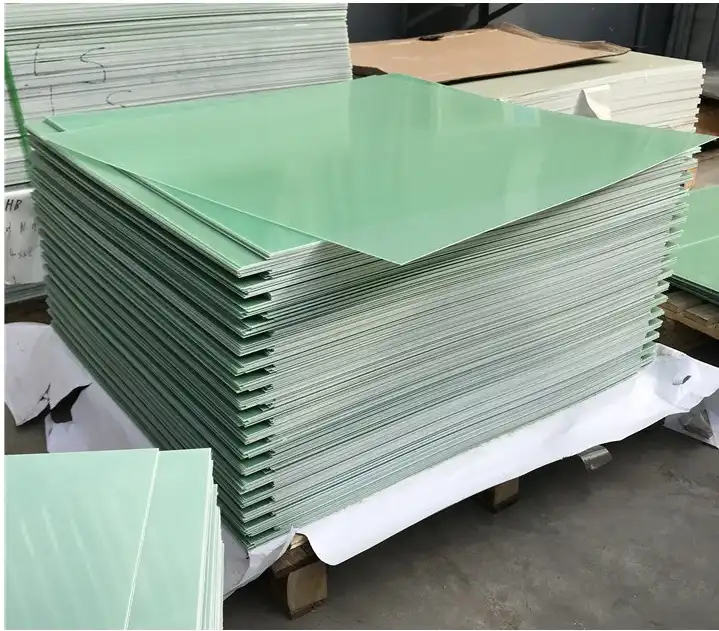
Understanding Thick G10 Epoxy Sheets and Their Properties
Thick epoxy glass laminates are a specific type of industrial thermosetting material that is made by carefully placing different layers on top of each other. Epoxy resin is mixed with several pieces of continuous fiber glass cloth and then squished together under a lot of heat and pressure until the resin hardens completely. This method makes a solid structure from multiple layers that are fused together fully. This eliminates the chance of delamination that happens with lower-quality composites.
Composition and Manufacturing Process
The stuff is made of tightly knit fiberglass cloth that has high-quality epoxy resin systems mixed into it. During production, sheets are stacked to get the sizes that are needed, which can be anywhere from a few millimeters to 12 mm or more. Temperatures are carefully controlled during the curing process, which usually takes place between 130°C and 140°C. This lets the resin cross-link and firmly connect with the glass support. This way of making things gives the material great structural stability and a moisture absorption rate well below 0.1%, which makes it perfect for use in wet or muggy places.
Key Mechanical and Electrical Properties
The material that is made has amazing physical properties that directly affect how it behaves when it is machined. The tensile strength is around 40,000 psi, and the compression strength is up to 65,000 psi. Flexural strength, which shows how resistant a material is to bending forces, is usually measured in pounds per square inch (psi). The mechanical qualities come from the way the glass support and epoxy material work together. The material keeps its great insulating strength, which makes it perfect for electrical insulation jobs where voltage breakdown resistance is very important. Its low rate of thermal expansion makes sure that parts stay within exact specs even when the temperature changes.
Material Grades and Variations
Standard formulations meet most of the needs of industry, but specialized grades meet particular performance goals. The material doesn't absorb much water, so its dimensions don't change in places with a lot of humidity. This makes it perfect for engineering problems where phenolic paper laminates would fail. In contrast to thermoplastics, which change shape when mechanical stress is applied over time, these G10 epoxy sheets keep their shape under heavy loads without adding too much weight. Because of these qualities, they are essential in the making of electrical equipment, industrial tools, power plants, cars, and appliances.
Challenges in CNC Milling of Thick G10 Epoxy Sheets and Problem Analysis
When CNC cutting thick epoxy fiberglass laminates, there are certain issues that can come up that can lower the quality of the parts and make production more expensive. The fundamental properties of the material make it very hard to machine in ways that are very different from working with normal metals or softer plastics.
Delamination and Edge Quality Issues
The layered structure of the knitted glass cloth in the epoxy matrix makes natural fracture lines that can be broken when the material is cut. When tools aren't engaged properly, layers can separate, which can lead to bad edge quality and errors in measurements. This kind of delamination usually happens when cutting forces are stronger than the interlaminar bond strength, especially where the layers meet and leave each other with little support. Because glass fibers are oriented in a certain direction, cutting across the weave pattern creates different forces than cutting parallel to the fiber direction. This means that adaptable machining methods are needed.
Heat Generation and Thermal Management
The material has a low thermal conductivity (about 0.3 W/mK), which makes it hard to control the heat during milling. Epoxy materials keep heat at the cutting surface longer than aluminum or steel, which quickly loses heat when cut. When temperatures get too high, the resin matrix gets soft. This causes smearing, a rough surface, and faster tool wear. When temperatures get close to 130°C, which is the material's glass transition point, the epoxy loses its stiffness. This makes the material bend and cause mistakes in its dimensions. This problem is made worse by thick parts because heat inside has fewer ways to escape.
Accelerated Tool Wear
The fact that fiberglass support is very rough makes it one of the hardest materials to machine. Silica in glass strands is about a 7 on the Mohs scale, which means it is harder than many materials used to make cutting tools. Standard high-speed steel or bare carbide cuts get dull very quickly on this surface, sometimes within minutes of use. Tool wear shows up as higher cutting forces, higher temps, and worsening surface quality. When cutting, fine glass dust is made, which works as an extra abrasive, grinding against tool surfaces and speeding up wear and tear. Dust particles can also hurt your lungs and damage parts of machines that aren't covered.
Dimensional Accuracy Complications
When several things work together, they make it harder to get tight tolerances. Dimensional drift is caused by a number of things, including material springback after the tool has passed through it, heat expansion during cutting, and uneven tool wear patterns. When thick pieces are cured, they may have internal stresses that come out when the material is removed, causing them to twist in ways that were not expected. Inconsistent feed rates in complicated shapes lead to changing heat profiles that cause localized changes in dimensions for the G10 epoxy sheets.
Optimized CNC Milling Strategies for Thick G10 Epoxy Sheets
To solve the problems with cutting, you need to use the right tools, set the settings correctly, and use good cooling methods. Together, these methods make it possible to make good parts while keeping costs low.
Strategic Tool Selection
Choosing the right cutting tools is the most important part of grinding. Diamond-coated end mills work better for mass production because diamond is very hard and doesn't wear down easily when it comes into contact with glass strands. Although they cost more at first, these tools keep their sharp cutting tips for a much longer time than other options. When used with the right cutting settings, tungsten carbide cutters with special coatings can be a cheap option for reasonable production numbers. They have a good tool life.
Cutting Parameter Optimization
Spindle speed and feed rate are the two most important factors that determine the quality and economy of grinding. For tools with a diameter of 6mm to 12mm, the best spinning speeds are usually between 12,000 and 18,000 RPM, but the exact numbers rely on the material and coating of the tool. Higher speeds lower the cutting forces per tooth contact but make it more likely that heat will build up. Feed rates of 1,500 to 3,000 mm/min are good for getting rid of waste and controlling heat. When passes are slow, heat can build up at the cutting edge, but when speeds are too high, the tool can't cut anything.
Cooling and Chip Management Techniques
When cutting thick epoxy laminates, thermal control is what makes the difference between successful and unsuccessful operations. By directing compressed air jets at the cutting zone, air blast cooling successfully gets rid of heat and chips without adding wetness that some materials can't handle. Cooling systems with vortex tubes send out streams of cool air that greatly lower the temperature for cutting while keeping the area dry. The cold air also helps any glue that has become soft to harden, which improves the quality of the surface finish for each G10 epoxy sheet.
Advanced Milling Approaches
Adaptive milling strategies use the abilities of CNC controllers to constantly improve cutting conditions. By using circular arc movements instead of straight cuts, trochoidal milling tracks keep the tool engaged at all times. This spreads heat more widely and lowers the peak cutting forces. This method works especially well when cutting holes or pockets in thick materials. Climb milling, in which the movement of the tool fits the direction of the feed, makes the edge better because it presses fibers together before the cut instead of lifting them. This direction lowers the chance of delamination and makes the surface finish better.
Comparing G10 Epoxy Sheet Milling with Other Materials
When buying teams know how G10 epoxy sheets stack up against other materials, they can make smart choices that balance performance needs with the cost of cutting.
Comparison with FR4 Laminates
People often get these products mixed up, but there are small but important differences between them. FR4 refers to flame-retardant mixtures with brominated chemicals that have UL94 V-0 grades and can put out fires on their own. Standard formulas that don't have flame retardants are a little easier to machine because the resin systems are softer, but most current materials have dual ratings that meet both requirements. The changes in cutting aren't that big; the same tools and settings work well for both. FR4 is better for uses that need to meet strict fire safety standards because it doesn't catch fire, but standard types may be slightly cheaper.
Phenolic and Paper-Based Laminates
Using phenolic cotton cloth laminates is very different from using other materials. Because the phenolic resin systems are softer and the support is cotton instead of fiberglass, these materials are easier to make with less aggressive tools. They do, however, have a lot less mechanical strength and can absorb more water—often more than 1.5%, compared to 0.1% for epoxy glass. Because they are sensitive to moisture, phenolic materials lose their shape in damp places, making them unsuitable for precise uses or situations where they might get wet. The better performance comes at the cost of being easier to machine.
Carbon Fiber Composites
Epoxy products with carbon fiber reinforcement use the same glue systems, but instead of glass reinforcement, they use carbon fibers. Carbon is much more rough than fiberglass, which makes tool wear go much faster. For carbon fiber cutting, diamond tools are no longer a choice; they are required. The material is electrically conductive, which is different from glass epoxy's insulating qualities. This means it can't be used in electrical uses, but it is useful for getting rid of static electricity. Because carbon fiber is more expensive, it is usually only used in situations that need the highest strength-to-weight ratios.
Thickness Selection and Trade-offs
Both machinability and application suitability are directly affected by the thickness of the material. Thinner sheets (less than 3 mm) are easier to machine because they don't build up as much heat and require less cutting force. This makes them perfect for making precise electrical parts. The thicknesses in the middle, from 3 mm to 8 mm, are good for most industrial insulation and mechanical uses because they are a good mix between ease of machining and strength. It's hardest to machine pieces that are thicker than 8 mm, but they are the strongest and can be used for structural parts, load-bearing spaces, and heavy-duty insulation barriers. When making decisions about what to buy, thickness should be matched to useful needs to get the most out of every G10 epoxy sheet.
Procurement Considerations for Thick G10 Epoxy Sheets in CNC Milling Applications
Choosing where to get materials has a big effect on how quickly and well the parts are made. When you do strategic buying, you don't just compare prices; you also look at the skills of the suppliers and the stability of the materials.
Supplier Evaluation Criteria
When choosing providers, material uniformity is the most important thing to think about. Changes in the resin content, cure profiles, or quality of the glass cloth make the machining behavior uncertain, which throws off production plans and makes more scrap. Manufacturers who are certified to use ISO quality control systems show proof that their products are consistent from batch to batch. Material quality can be objectively checked by lab records that prove its mechanical properties, electrical characteristics, and dimensional tolerances. Suppliers that have been making things for decades usually have tighter process controls than younger businesses.
Customization and Order Specifications
Standardization of sheet sizes changes around the world, so making sure you know the exact sizes ahead of time saves you money. When material output has a big effect on prices, custom sizing choices become more cost-effective for high-volume uses. Pay close attention to thickness tolerances; tighter tolerances raise the cost of materials but may cut down on cutting. The surface finish specs affect both how the part looks and how it is machined later on. For example, as-molded surfaces machine differently than smoothed surfaces on the G10 epoxy sheets.
Logistics and Support Services
Integrated logistics skills make buying things from other countries easier by putting shipping, clearing customs, and organizing deliveries under the control of a single source. Suppliers who handle their own transportation are more responsible for keeping track of shipments than those who use third-party freight forwarders. Good packaging keeps things safe while they're being shipped; bad packaging lets water or damage in, which changes the features of the things being shipped.
Conclusion
To successfully CNC mill thick epoxy glass laminates, you need to use methods that take into account the properties of the material, the choice of tools, the cutting settings, and how to handle heat. The material is very strong, doesn't conduct electricity or chemicals, and is resistant to many chemicals. It is used in many industries, but it is hard to machine because it is rough and doesn't conduct heat well. These problems can be solved by using diamond-coated or carbide tools, spindle speeds that are just right, careful feed rates, and good cooling techniques to make accurate parts quickly. Buying G10 epoxy sheets from skilled providers on a strategic level ensures consistency, which is important for knowing what will happen in the manufacturing process.
FAQ
What thickness range is optimal for CNC milling operations?
The best mix between being easy to machine and being strong is found in materials that are 3mm to 8mm thick. Thinner pieces (less than 3 mm) are easy to make but don't have much mechanical strength. Thick pieces (more than 10 mm) generate a lot of heat and need more conservative cutting settings. The best thickness varies on the job. For example, electrical insulation parts need thinner materials, while solid mechanical parts need thicker sections. By choosing the right G10 epoxy sheet width for the job instead of ones that are too thick, machining time and equipment costs can be cut.
How can tool wear be minimized during milling?
Diamond-coated end mills have the longest tool life, but tungsten carbide with the right coats works just as well and costs less for small to medium production rates. Making sure you keep the right cutting settings stops too much heat that speeds up wear. Usually, spindle speeds between 12,000 and 18,000 RPM and feed rates between 1,500 and 3,000 mm/min work well. Cuts with a shallow depth spread forces over more tool movements, which lowers stress at the moment. Using the right flute design and air blast cooling to effectively remove chips stops the buildup of gritty dust that speeds up tool wear.
What distinguishes machining epoxy glass from FR4 materials?
Most current formulations meet both requirements, so the materials are almost similar in how they work when machined. FR4 stands for flame-resistant versions with brominated additives that meet UL94 V-0 standards. This flame protection doesn't make it harder to machine—the same tools and settings work well for both materials. The difference is mostly about what the application needs and not about how it should be machined. FR4 is better when fire safety rules require it to have self-extinguishing qualities.
Partner with J&Q for Superior G10 Epoxy Sheet Solutions
J&Q has been making and providing high-performance insulation materials to difficult industrial uses around the world for more than 20 years. Our engineering team knows how important it is for material quality and cutting efficiency to work together. That's why we offer G10 epoxy sheets with consistent properties that give reliable CNC milling results. As a well-known company that makes these products, we can give unique sizes that cut down on waste and production costs. Our integrated logistics services make sure that delivery dates are kept, and our expert support team helps you find the best parameters for your projects. Get in touch with our experts at info@jhd-material.com to talk about your needs and find out how our factory-direct prices and one-stop service can help your supply chain.
References
National Electrical Manufacturers Association (NEMA), "Industrial Laminating Thermosetting Products Standard," Publication LI 1-2020, American National Standards Institute, 2020.
Campbell, F.C., "Structural Composite Materials: Manufacturing Processes and Properties," ASM International Materials Engineering Series, 2010.
Davies, J.R., "High-Performance Composite Materials Handbook: Fabrication and Machining Techniques," Society of Manufacturing Engineers Technical Publications, 2018.
Weinert, K. and Kempmann, C., "Cutting Temperatures and Their Effects on the Machining Behaviour of Reinforced Plastics," Advanced Manufacturing Technology Journal, Volume 58, 2012.
Sheikh-Ahmad, J., "Machining of Polymer Composites: Tool Wear and Surface Integrity Considerations," Springer Manufacturing Engineering Series, 2016.
Zhang, L. and Wang, S., "Optimization of Milling Parameters for Glass Fiber Reinforced Polymer Composites," International Journal of Advanced Manufacturing Technology, Volume 89, 2017.

Get a complete product list and quotation

J&Q New Composite Materials Company



