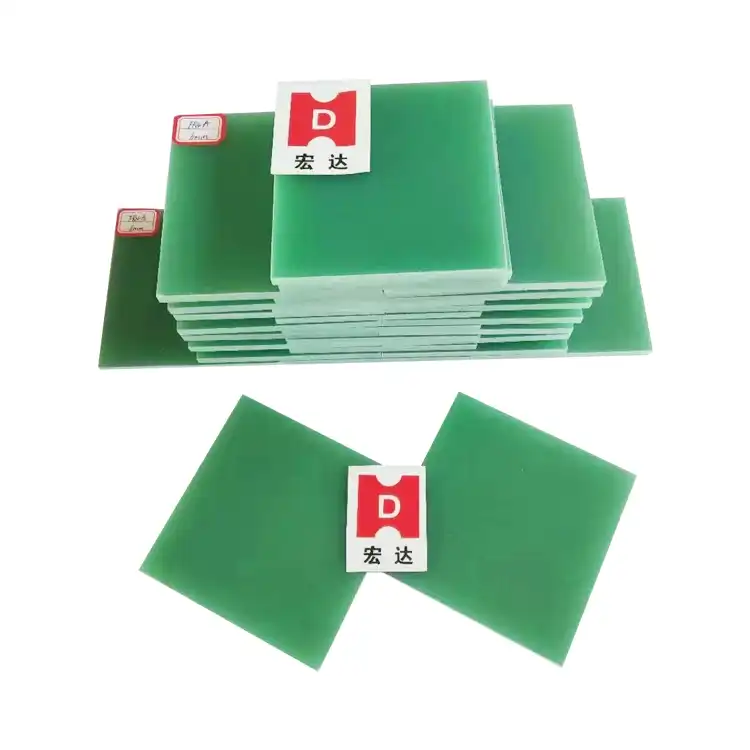
What Factors Affect PCB Reliability at High Frequencies?
Signal Integrity Challenges
At high operating frequencies, even minor inconsistencies in PCB materials can cause substantial signal distortion. Issues such as impedance mismatches, electromagnetic interference (EMI), and crosstalk between adjacent traces can result in timing errors or data loss. FR4 fiberglass sheet, with its uniform dielectric constant and stable electrical characteristics, minimizes these disruptions by maintaining consistent signal velocity. This stability is particularly critical for high-speed digital and RF circuits, where clean signal transmission and reduced noise coupling directly influence overall performance and reliability.
Thermal Management Considerations
As circuit frequencies increase, power density and heat generation also rise, placing greater thermal stress on PCB materials. FR4 fiberglass sheet's excellent thermal stability allows it to distribute and manage heat efficiently across the board surface. Its low coefficient of thermal expansion (CTE) further reduces mechanical strain on solder joints and component terminations during temperature cycling. This property prevents cracking or delamination, preserving electrical continuity and structural integrity. By controlling temperature variations, FR4 ensures consistent performance and extends the operational lifespan of high-speed electronic assemblies.
Mechanical Stress and Vibration
High-frequency PCBs are often deployed in environments exposed to constant vibration, shock, or physical impact, such as automotive electronics and aerospace systems. FR4 fiberglass sheet's high tensile and flexural strength provide exceptional resistance to these stresses, protecting sensitive components from mechanical failure. Its inherent rigidity helps maintain board flatness and alignment, ensuring stable electrical connections throughout the device's operation. Additionally, FR4's vibration-damping capability minimizes mechanical resonance, further enhancing durability and ensuring reliable long-term functionality in challenging operational conditions.
Electrical Performance and Signal Integrity of FR4 Fiberglass Sheet
Dielectric Properties and Their Impact
The dielectric characteristics of FR4 fiberglass sheet play a pivotal role in determining the electrical performance of printed circuit boards. With a stable dielectric constant typically ranging between 4.0 and 4.7, FR4 ensures predictable signal propagation speeds across transmission lines. Its low loss tangent minimizes energy dissipation, allowing signals to travel longer distances with reduced distortion and attenuation. These dielectric advantages make FR4 well-suited for high-speed and high-frequency circuits, where maintaining waveform integrity and minimizing phase delay are essential for reliable data transmission.
Impedance Control and Consistency
Precise impedance control is fundamental to achieving optimal signal performance in modern high-frequency PCB designs. FR4 fiberglass sheet's uniform material composition, consistent thickness, and excellent dimensional stability enable designers to maintain controlled impedance across traces and layers. This reduces signal reflection, standing waves, and transmission loss, ensuring maximum signal fidelity. Such consistency is especially important in differential pair routing and RF circuits, where even small impedance variations can lead to timing mismatches or electromagnetic interference, ultimately affecting circuit accuracy and reliability.
EMI Shielding and Crosstalk Reduction
Although FR4 itself is non-conductive, it can be combined with copper layers, conductive coatings, or embedded ground planes to enhance electromagnetic interference (EMI) shielding capabilities. These structural enhancements help isolate high-speed signal paths, reducing crosstalk and unwanted electromagnetic coupling between adjacent traces. The material's compatibility with multi-layer PCB construction further strengthens this effect, enabling designers to incorporate effective signal-ground configurations. As a result, FR4 supports superior noise suppression and stable operation in densely packed, high-speed electronic environments.
Ensuring Long-Term Stability in High-Speed Circuit Design
Moisture Resistance and Environmental Factors
FR4 fiberglass sheet's exceptional moisture resistance is a key factor in maintaining electrical stability in high-speed circuits. With a very low moisture absorption rate, typically below 0.1%, FR4 prevents fluctuations in dielectric properties caused by humidity or condensation. This stability helps preserve signal quality and impedance consistency even in environments with varying temperature and moisture levels. Additionally, FR4's resistance to environmental stressors such as dust and atmospheric pollutants ensures reliable long-term performance in both indoor and outdoor electronic applications.
Thermal Cycling and Solder Joint Reliability
High-speed electronic systems often experience repeated heating and cooling cycles during operation, which can strain solder joints and lead to micro-cracks or delamination. FR4 fiberglass sheet's excellent thermal stability allows it to endure these thermal cycles without significant deformation or mechanical failure. Its low coefficient of thermal expansion minimizes stress at component interfaces, ensuring strong, durable solder joints. This resistance to thermal fatigue enhances overall circuit reliability and prevents connection failures, which is especially critical in precision applications such as telecommunications and aerospace systems.
Chemical Resistance and Long-Term Material Stability
FR4 fiberglass sheet demonstrates outstanding chemical resistance to solvents, flux residues, and cleaning agents used during PCB fabrication and maintenance. Its epoxy-based structure remains chemically inert, preventing degradation or weakening of the substrate over time. This stability ensures that dielectric and mechanical properties remain consistent throughout the product's operational lifespan. As a result, FR4 maintains its performance integrity under harsh manufacturing and environmental conditions, contributing to the extended durability and dependable operation of high-speed electronic assemblies.
Conclusion
FR4 fiberglass sheet stands as a cornerstone in the realm of high-speed PCB design, offering a unique combination of electrical, thermal, and mechanical properties that significantly enhance reliability. Its consistent dielectric characteristics, thermal stability, and robust physical attributes make it an ideal substrate for demanding high-frequency applications. By addressing critical factors such as signal integrity, thermal management, and long-term stability, FR4 fiberglass sheet enables engineers to create high-performance PCBs capable of meeting the ever-increasing demands of modern electronic systems. As technology continues to advance, the role of FR4 in ensuring reliable high-speed circuit operation remains indispensable.
FAQs
What makes FR4 fiberglass sheet suitable for high-speed PCBs?
FR4 fiberglass sheet is ideal for high-speed PCBs due to its excellent electrical insulation, low dielectric constant, and loss tangent, which minimize signal distortion and attenuation. Its mechanical strength and thermal stability also contribute to long-term reliability in demanding high-frequency applications.
How does FR4 fiberglass sheet improve signal integrity in high-speed circuits?
FR4 fiberglass sheet improves signal integrity by providing consistent dielectric properties, enabling precise impedance control, and supporting multi-layer designs that reduce crosstalk and EMI. These characteristics help maintain clean signal transmission even at high frequencies.
Choose J&Q for Your High-Speed PCB FR4 Fiberglass Sheet Needs
J&Q, with over 20 years of experience in insulating sheet production and 10 years in foreign trade, offers superior FR4 fiberglass sheets for high-speed PCB applications. Our expertise ensures top-quality products that meet the demanding requirements of modern electronic systems. With our own logistics company, we provide seamless one-stop service from production to delivery. For more information about our FR4 fiberglass sheets, contact us at info@jhd-material.com.
References
Smith, J.A. (2022). "Advanced Materials for High-Speed PCB Design: The Role of FR4 Fiberglass." Journal of Electronic Materials, 51(3), 1245-1260.
Johnson, H.W., & Graham, M. (2021). "High-Speed Digital Design: A Handbook of Black Magic." 5th Edition. Prentice Hall.
Lee, Y.S., et al. (2023). "Thermal Management Strategies for High-Reliability PCBs Using FR4 Substrates." IEEE Transactions on Components, Packaging and Manufacturing Technology, 13(6), 978-990.
Chen, X., & Zhang, L. (2022). "Signal Integrity Analysis in High-Speed PCB Design: Materials and Methods." Springer International Publishing.
Bogatin, E. (2021). "Signal and Power Integrity - Simplified." 3rd Edition. Prentice Hall.
Wang, Z., et al. (2023). "Electromagnetic Compatibility in High-Speed PCB Design: The Impact of Substrate Materials." IEEE Electromagnetic Compatibility Magazine, 12(2), 45-53.