Custom CNC Machined Bakelite Parts vs. Injection Molding: A Cost Analysis
When engineering managers have to make choices about how to make custom phenolic resin parts, they often have to answer a basic question: Should we spend money on CNC machining or injection molding to make our Bakelite parts? The answer depends on how much the tools cost up front, how much each unit costs, how much is being made, and how long the deadline is. CNC machining doesn't require expensive mold making, so it's affordable for prototypes and orders of less than 500 units. Injection molding, on the other hand, has huge cost savings when it comes to volumes over 5,000 pieces, even though it requires big investments in initial tooling. This study looks at the real factors that affect costs, which helps procurement teams match production methods with actual budgets and needs.
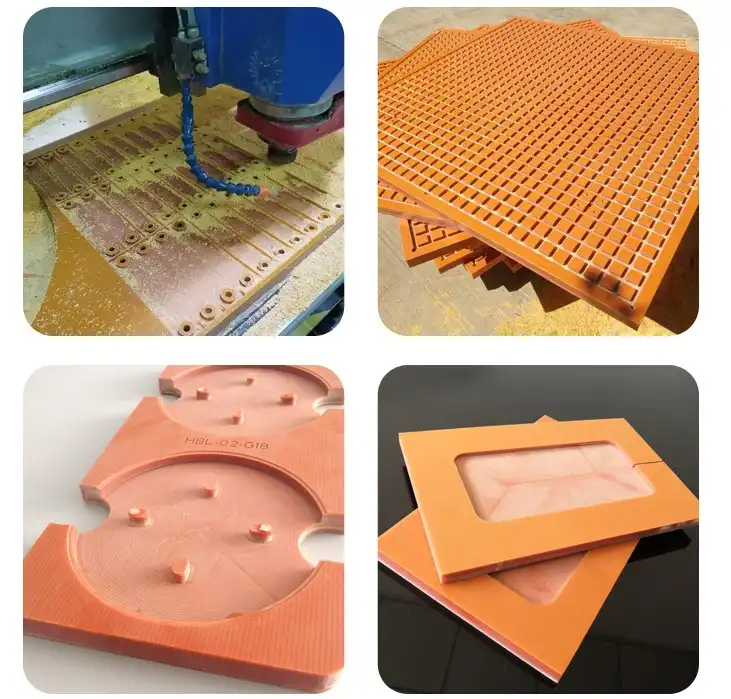
Understanding Bakelite Parts and Their Manufacturing Methods
Why Bakelite Remains Essential in Modern Manufacturing?
Even though newer engineering plastics are competing with phenolic resin parts, they are still very important in electrical, automotive, and industrial settings. Because it is thermosetting, this material has a dielectric strength of more than 12 kV/mm and stays stable at temperatures up to 300°F, which are qualities that thermoplastics have a hard time matching. Companies that make things use these materials for motor parts, transformer barriers, and switchgear assemblies because they stay the same size even when heated and cooled many times.
Because it doesn't absorb more than 0.5% of moisture and doesn't conduct electricity, the material is essential for power distribution equipment. When heated for a long time, thermoplastics that can be injected soften. But cured phenolic structures stay strong throughout their service life. When designing safety-critical insulation systems, engineering teams value this level of dependability.
CNC Machining: Precision Without Mold Investment
Through subtractive manufacturing, computer numerical control machining turns solid phenolic sheets into finished Bakelite parts. Mills and lathes with multiple axes can cut stock material from 0.5 mm to 50 mm thick into complex shapes with accuracy of ±0.05 mm. This method works well for complicated designs that need threaded holes, undercuts, or different wall thicknesses that would need expensive multi-cavity molds.
One clear benefit is that production can be changed to fit different needs. When engineering changes, updated toolpaths are all that's needed instead of costly mold changes. Purchasing teams that are putting out new products like that they can make changes to designs between batches without having to pay extra. Rapid prototyping cycles that shorten development schedules are made possible by setup times measured in hours instead of weeks.
Material waste is a trade-off because the chips that are taken off during machining can't be used again. For projects that need odd sizes, this method works well because manufacturers like J&Q keep a large stock of certified phenolic laminates and can easily make sheets with any thickness.
Injection Molding: Volume Production Economics
Under very high pressure, injection molding forces melted phenolic compounds into precise steel cavities. This makes identical parts very quickly. Modern presses cycle every 30 to 90 seconds, depending on the shape of the part. This lets them make more than 1,000 units every day. This repeatability makes sure that measurements are always the same in a way that manual processes can't, which is very important for automated assembly lines in the appliance manufacturing industry.
The main cost obstacle is the tooling. Hardened steel multi-cavity molds can range in price from $15,000 to $75,000, depending on how complicated they are and how many cavities they have. To pay for this investment over time, you need to make a lot of them so that the savings on each one cover the initial cost. Because resin pellets melt precisely to fill cavity volumes with little waste, material efficiency goes up by a huge amount.
The quality of the surface finish comes directly from the mold, so there are no extra steps needed. When making housings that need to have certain creepage distances, companies that make electrical components like this consistency. One problem with the process is that it's hard to get very tight tolerances on large parts, and you can't use threaded metal inserts without doing extra work.
Cost Components and Comparison Between CNC Machining and Injection Molding
Breaking Down CNC Machining Expenses
To find out how much CNC-made Bakelite parts really cost, you have to look at more than just the price of the raw materials. Sheet stock usually costs between $8 and $25 per kilogram, depending on the grade and certification needs. Grades that meet UL94 V-0 flame ratings command higher prices. Material utilization efficiency changes a lot depending on the shape of the part. Simple rectangular parts have a 60–70% yield, while complex shapes with lots of cutouts may waste 50% or more.
Direct production costs are affected by machine time in a big way. Normal three-axis mills can work with phenolic materials at speeds of 200 to 400 mm per minute, based on the complexity of the feature and the finish that is needed on the surface. Setting up the programming for the first runs takes two to four hours of engineering time, but this cost is spread out over multiple batches. It's easier for bigger production houses to handle these costs because they can handle more orders at once.
Tooling wear is an ongoing cost that is often missed in early estimates. Phenolic materials have abrasive fillers that speed up the wear and tear on cutting tools. This means that carbide endmills need to be replaced every 15 to 20 hours of machining time. For multi-sided operations, labor intensity is still higher than molding because operators have to handle each part separately. However, automation lowers this factor in high-volume shops.
Injection Molding Cost Structure
Molded phenolic parts have very different economics, which are mainly based on the upfront cost of the tools. Depending on how complicated the mold is, it can take anywhere from 6 to 12 weeks to make. During this time, no production happens. This delay affects plans for when products will come out and how much cash will flow. The long life of tools helps to cover some of their initial costs; well-kept steel molds can be used 100,000 to 500,000 times before they need to be fixed up.
When compared to machining, the cost of materials per piece goes down a lot because injection-grade phenolic compounds only cost $6 to $18 per kilogram and less than 5% of them are wasted. Cycle times show how efficiently workers are using their time, since one operator can watch over multiple presses that make hundreds of parts every hour. When the number of units sold goes over a few thousand, this productivity advantage becomes very important.
Mold maintenance, quality inspection protocols for verifying dimensions, and inventory carrying costs for minimum order quantities are all examples of hidden costs. Suppliers usually need orders for 3,000 to 10,000 pieces before they will set up a mold. This means that smaller procurement budgets have to deal with higher working capital needs. When production schedules change without warning, it's hard to work around lead times.
Volume Crossover Analysis
The decision about the manufacturing method comes down to the economics of the order quantity. CNC machining is almost always better for projects with fewer than 500 parts because the costs of the tools never pay for themselves. In the 500–2,000 unit range, there is a gray area where the best approach depends on the complexity of the part, the tolerance requirements, and how quickly the delivery needs to happen.
When compared to machined options, injection molding saves between 40 and 70% on each piece for orders over 5,000. This volume threshold is often surpassed by automotive tier-one suppliers making battery pack barriers or appliance manufacturers needing thousands of motor mounting brackets. It's important to make yearly volume predictions because combining several small orders into quarterly production runs lowers the cost of molding by reducing the number of times it needs to be set up.
When engineering managers model a program's total costs, they should include the costs of design iteration. Because machining is so flexible, projects that expect to make a lot of changes during the development phase can use it first and then switch to molding after the design freeze. This staged approach strikes a good balance between quick development and quick production.
Performance and Durability Comparison of Bakelite Parts by Manufacturing Method
Mechanical Precision and Surface Quality
When Bakelite parts are CNC machined, they can have tighter tolerances on important dimensions, especially when features need to be perfectly perpendicular or concentric. Five-axis machining centers can make complicated shapes that hold key dimensions to within ±0.03mm, which is important for mechanical spacers used in industrial machinery. The roughness of the surface is usually between 1.6 and 3.2μm, but this depends on the tool used and the feed rate.
Injection-molded parts are very repeatable from one part to the next, but the exact dimensions depend on how well the mold is made and how much the material shrinks. For sizes smaller than 50mm, the standard range of tolerances is ±0.1 to 0.15mm, and premium tools can be used to make them tighter. The finish on the surface is glossy and even, which is good for electrical uses where smooth surfaces lower voltage stress concentrations.
Different methods have different patterns of internal stress. When material doesn't change phases during machining, there isn't much residual stress. Injection molding, on the other hand, creates stress gradients as the molten resin cools at different rates across the thickness of the part. This difference has an effect on the long-term stability of the dimensions in thermally cycled applications like transformer barriers.
Thermal and Electrical Performance Characteristics
Since behavior is controlled by the properties of the base material, both ways of making parts meet the same thermal performance requirements. No matter how they are made, phenolic laminates keep their mechanical strength at constant operating temperatures of 280 to 300°F. Heat deflection temperatures stay the same, which makes sure that motor parts and switchgear insulators work reliably when electrical loads are applied for a long time.
When made correctly, there isn't much difference in dielectric strength between machined and molded phenolic parts. Values tested always go above 10 kV/mm thickness, which is good enough for isolating busbars and making high-voltage fuse blocks. According to ASTM D495 testing, arc resistance is higher than 120 seconds. This stops carbon from moving across insulating surfaces when there is a fault.
When materials are homogeneous, they are less reliable over time. Laminated phenolic sheets are used in CNC machining. They have oriented fiber reinforcement that gives them directional strength. The procurement teams need to say how the machining should be set up in relation to the load directions. Injection-molded parts have more isotropic properties because the resin flows evenly into the holes. However, weld lines where flow fronts meet can be weak spots in complicated shapes.
Chemical Resistance and Environmental Durability
No matter how they are made, phenolic resin structures can stand up to most industrial chemicals, such as weak acids, petroleum products, and alkaline solutions. Because of this, the parts can be used in both automotive under-hood applications and industrial control enclosures that will be cleaned with solvents. After 24 hours of immersion, the material still absorbs less than 0.5% of its own weight in water, keeping its shape in humid places.
Long-term exposure to ultraviolet light breaks down surfaces, but this doesn't usually happen to parts in enclosed electrical assemblies. Protective coatings that are added after the product is made are better for use outdoors. Neither machining nor molding naturally resist UV light; the environmental durability depends on the material used and how it is treated on the outside.
When it comes to gears and bearing surfaces, wear resistance depends more on the type of material used than on how it was made. Glass-filled phenolic grades are easy to machine and have better resistance to wear than paper-based laminates. When engineers are choosing materials for wear applications, they should put filler type ahead of production method if both meet the geometric needs.
Conclusion
To choose between CNC machining and injection molding for phenolic parts, you need to carefully look at the number of orders, the complexity of the parts, and the schedule for the programs. CNC machining is best for prototypes and orders of less than 1,000 units because it doesn't require investing in tools, lets designers make changes quickly, and achieves tight tolerances. Even though the molds are expensive to buy up front, injection molding is more cost-effective than other methods for making more than 5,000 pieces because it makes better use of materials and labor. Instead of focusing on per-piece prices, procurement teams should look at the total costs of the program, which should include any possible changes to the design. Working with skilled manufacturers who can do both gives you strategic flexibility throughout the lifecycle of a product, balancing quick development with efficient production of every Bakelite part.
FAQ
How do the lead times for machining and molding compare?
CNC machining usually delivers the first Bakelite parts within one to three weeks because no tools need to be made. Setting up only requires programming and getting materials. For injection molding, building the mold takes 6 to 12 weeks before the first products come out, but later production runs are finished quickly. Rush tooling services shorten this time frame for an extra fee. When engineering teams have to make prototypes quickly, they almost always choose machining. Once the design is finalized, they switch to molding for larger production runs.
Can both of these methods get UL approval for electrical uses?
When certified base materials are used, parts made by either method meet UL94 standards for electrical performance and flammability. The certification is based on the composition of the material, not the way it was made. Teams in charge of buying things should make sure that the phenolic sheets or molding compounds they get have the right UL recognition marks on them. Manufacturers like J&Q keep track of the material certifications and traceability paperwork that are needed to qualify electrical components.
What is the lowest amount that buyers should be able to order?
CNC machining can handle orders as small as one piece, but after 50 units, the cost per unit drops by a lot as the setup costs are spread out. Most injection molding suppliers need at least 1,000 to 3,000 pieces to cover the time it takes to set up and change the mold. Some manufacturers offer lower minimums by charging more or keeping special molds for customers who buy from them again and again. Talking about annual volume projections during the first conversations helps suppliers come up with cost-effective ways to place orders.
Partner with J&Q for Expert Bakelite Part Manufacturing
Over twenty years of specialized experience have helped J&Q make precise phenolic parts for tough electrical and industrial uses. Because we can do both CNC machining and injection molding, our engineering teams can find the best ways to make products at all stages of their lives, from making quick prototypes to mass production. Every Bakelite part is checked by in-house quality systems to make sure it meets certain electrical performance standards and tolerances. The materials used are fully documented and UL compliance is shown.
In addition to manufacturing expertise, our integrated logistics network makes it easier to buy things from other countries by streamlining the supply chain management. Our technical team works with your engineers to find the most cost-effective way to do things, whether you need 50 machined prototypes or 50,000 molded production parts. Get in touch with our purchasing experts at info@jhd-material.com to talk about the needs of your project. As a well-known company that makes Bakelite parts for OEMs around the world, we can give your applications the quality consistency and production flexibility they need.
References
Harper, C.A. (2018). Handbook of Plastics Technologies: The Complete Guide to Properties and Performance. McGraw-Hill Professional.
Richardson, T. & Lokensgard, E. (2020). Industrial Plastics: Theory and Applications. Cengage Learning.
Mallick, P.K. (2021). Thermosets and Composites: Material Selection, Applications, Manufacturing and Cost Analysis. CRC Press.
Society of Plastics Engineers (2019). Injection Molding Handbook: The Complete Molding Operation Technology, Performance, and Economics. Hanser Publications.
Kalpakjian, S. & Schmid, S.R. (2017). Manufacturing Engineering and Technology: CNC Machining and Manufacturing Processes. Pearson Education.
ASTM International (2022). Standards for Electrical Insulating Materials: Phenolic Compounds and Laminates. ASTM Volume 10.02 Electrical Insulation Standards.

Get a complete product list and quotation

J&Q New Composite Materials Company



